"I thought I should ask of thee- but I dared not- the rose wreath thou hadst on thy neck. Thus I waited for the morning, when thou didst depart, to find a few fragments on the bed. And like a beggar I searched in the dawn only for a stray petal or two.
Ah me, what is it I find? What token left of thy love? It is no flower, no spices, no vase of perfumed water. It is thy mighty sword, flashing as a flame, heavy as a bolt of thunder. The young light of morning comes through the window and spreads itself upon my bed. The morning bird twitters and asks, 'Woman, what hast thou got?' No, it is no flower, nor spices, nor vase of perfumed water- it is thy dreadful sword.
I sit and muse in wonder, what gift is this of thine. I can find no place to hide it. I am ashamed to wear it, frail as I am, and it hurts me when I press it to my bosom. Yet shall I bear in my heart this honor of the burden of pain, this gift of thine.
From now there shall be no fear left for me in this world, and thou shalt be victorious in all my strife. Thou hast left death for my companion and I shall crown him with my life. Thy sword is with me to cut asunder my bonds, and there shall be no fear left for me in the world.
From now I leave off all petty decorations. Lord of my heart, no more shall there be for me waiting and weepting in corners, no more coyness and sweetness of demeanor. Thou has given me thy sword for adornment. No more doll's decorations for me!"
-Rabindranath Tagore, Gitanjali #52. (Translated from Bengali)
Wednesday, November 26, 2008


Tuesday, November 4, 2008
Here In America, part II
 I had ambitious plans to write a trans-America installment every day of my recent road trip, but WiFi limitations made this extremely difficult. So, I ditched the schedule and had a blast flying by the seat of my pants instead. Now I'm in Toledo, busily unpacking boxes and settling into my new apartment. Still, before I run off into a telling of all these newer tales, let me finish about my road trip. It was a deeply special time, something I will cherish for the rest of my life.
 So let's revisit Wednesday the 8th. I left Walla Walla, my beloved home. Andrew Peterson's song “Canaan Bound” gave me a lot of courage as I thought about the future and God's call on my life. Cat and Greg were indeed a special experience. A night in their cabin was also the last time I'd have a shower til I hit Iowa!
On Thursday the 9th I set off across Montana listening to Bruce Cockburn, my new sacred musical hero. Cockburn is a socially and politically astute Canadian singer/songwriter. But more than that, his lyrics are spiritual rich, deeply honest, and very beautiful. I heard him the weekend before my trip started at a University of Victoria child soldier's fundraiser. It was a duo event with
 General Romeo Dellaire, frustrated head of the UN's “Peacekeeping” mission to Rwanda during the genocide. (Also author of “Shake Hands With the Devil.” You saw his character depicted in the recent film “Hotel Rwanda.”) I have struggled so much to find a voice for my India experience. I have struggled to approach it humbly, honestly, and reverently all at the same time. But Romeo Dellaire did those things that night, and he did them well. He didn't set himself up as some hero, but he handled the ovations with grace-- they were the price he had to pay to tell the story we so badly needed to hear. Now, I would not be so obscene as to compare myself with a man like Dellaire. Kolkata was certainly not the Rwandan genocide. But in my own small way I resonated with his circumstance. After hearing him I felt emboldened, even convicted to talk about the things I haven't yet talked about-- the things I've been too afraid to talk about.
 And so Cockburn traveled on my lips through the rugged Montana wilderness (especially his song, “Child of the Wind.”) All these thoughts of sharing touched my heart as the sun touched the distance, and I drove on.
I arrived at Yellowstone (Wyoming) quite late on Thursday and
 slept in the cab of my truck. There was thick ice on the inside of my window the next morning, but I kept warm thanks to Nova and my down blanket. A park ranger informed me that I would need to go out the north entrance when I left because a winter storm watch had closed off the east entrance. I got busy driving around snow-covered Yellowstone so I could get out with enough time to make it to Sheridan, Wyoming that night. The steamy geysers looked other-worldly between our frozen earth and sky-- viewed through my melancholy eyes, they seemed extraordinarily dramatic. Unfortunately for me, Old Faithful was rather unfaithful on the day I visited. Apparently she did erupt, but the six inches were not visible from where I stood in the falling snow. Rich Mullins' “Love That Knows No Bounds” was my song that day.

I left Yellowstone by 2:00 but had to pull off the road after I got through Billings. The weather was so bad that I couldn't even see 6 feet in front of me! I slept at a truck stop and shoveled
 myself out of the snow the next morning.
On Sabbath I drove across Wyoming and into South Dakota with enough time to have a moving experience at both the Crazy Horse Memorial and Mount Rushmore. For the last several months I've been struggling to learn how to pray, and about six weeks ago I picked up a helpful discounted Richard Foster audiobook on prayer. Celebration of Discipline was a useful introduction to the spiritual disciplines, but not much more. His book on prayer, however, was extraordinary. I listened to it several times in the car while driving to and from Walla Walla, and it only increased my hunger for a deeper prayer experience-- one of intimacy and power.
I tasted some of that intimacy in South Dakota, and in ways I did not expect. At Crazy Horse
 I found myself very grieved over the story of Wounded Knee, the “white man's” battle with Native Americans on the frontier, America's continued bigotry, etc., etc. I of course grew up learning about Native issues, art, culture, and history, in school, but in South Dakota it really hit home for me in new ways. I was astonished by the beauty of Native American bead and leather work, by its culture's sensitivity to nature and the ways of the Great Spirit. I felt a profound shame for what the European settlers did to the keepers of this land, another drop into that widening sadness of cruel things human beings have done again and again to themselves and each other.
When I got to Mount Rushmore my sadness was very thick indeed, and staring up at those chiseled faces through the fog, all I could do was apologize to God for the sins of my country. I felt as if I had committed them myself-- as if I had stolen land and betrayed contracts with
 Native Americans, as if I had owned slaves, as if I had not shared from my abundance (and I haven't). I felt as if I had done all these things personally, and I felt moved to repent for them. In a very unusual prayer experience, I did. And when I found myself stumbling for a follow up, it occurred to me that in prayer I have always been accustomed to asking for something after a personal apology, like “and help me to be more kind.” Or, “please draw me closer into love.” But at Mount Rushmore there seemed nothing else to say, and I felt almost questioned by the Holy Spirit, “Why must you clutter this prayer with requests? Can you not be wearied? Can you not just grieve with me, feel with me?” Before I listened to Foster's tapes I probably would not have recognized this interaction as a genuine prayer experience, but this time I did. And through our shared sadness, we rejoiced.
Saturday night was spent in a Rapid City Walmart parking lot. It was beastly cold again, but my blankets (and Nova) kept me warm so long as I didn't step outside.
 Sunday was glorious. I sailed into the Black Hills and the Badlands early, blaring Rich Mullins' “Calling Out Your Name” as loud as my speakers would go. I have dreamed of driving through those two spots of South Dakota with that song on my lips. As long as I live I shall treasure the memory of those hours.
The Badlands were incredible-- so still and silent (like the song says). Why are we afraid to use our imaginations when we think of
 God? Why do we limit him to gold-crusted cathedrals and stale doctrine? Why can't we sing him? Why can't he dance through barren landscapes, illusive and lovely and free? We had a good time that day. Thank you, Brother Rich.
It was wonderfully eerie that night all alone under the stars. There was tension in my heart between dark adventure and the warm safety of my u-haul cab. The next morning I left early and booked it through Minnesota all the way to Iowa (via a sweet authentic 1880s town with Dances With Wolves props) for a very different sort of intimacy.
 I met Carolyn Dahl in Switzerland while I was studying at L'Abri. She was Edith Schaeffer's caretaker, and the whole Dahl family has been very involved with L'Abri for several decades. Carolyn has eight brothers and sisters, all of whom have been to L'Abri at some point. One of her sisters was even a worker at English L'Abri for a stint (that's how she met her husband). The Dahl parents are corn and soy bean farmers, and so I was delighted to be invited to to their home for some wholesome family time and fun. Oh, it was really so SO beautiful. We played board games and laughed our heads off. We drank tea and ate good food and had so many wonderful theological exchanges that we found it hard to keep talking and thinking in any one direction. Our board game would stop again and again for the sake of some really good comment or question or L'Abri story.
In the morning we all gathered for fresh bagels and cream cheese and more tea and more
 talking. Then we prayed together from the Book of Common Prayer and gathered around the piano for a lot of soulful music. Carolyn's fingers danced on the piano while her sister played the flute, her brother the guitar, and an in-law tapped a Celtic drum. With joy and gusto we sang “I Heard the Voice of Jesus Say” until it got so good that we actually recorded it! That was my European theme song, and Carolyn and I used to share it together in the Farrell House chapel in Switzerland.
It was very hard to pull myself away from the cornfields the next day, but by 2:00pm I was back on the road contentedly humming Andrew Peterson's “Queen of Iowa.” It was a long haul with Berrien Springs, Michigan my midnight goal, and unfortunately I didn't quite make it.
 Passing Illinois and Indiana, I finally crashed at another truck stop 45 minutes out of town. But Andrews came early the next day. Jody and I nearly knocked each other over when we collided in our tangle of hugs and shrieks and love just outside the seminary. She took me in for chapel service and there I bumped into several other old Walla Walla friends-- Andrew Perrin, Nick Jones, Robert Carlson, etc., etc. Unfortunately I missed Terrance and Jaci and Jenny Tillay and Brian Cafferky. Oh well. Guess you can't have everything. Thankfully I did have time for a chat with the good people of the In-Ministry (MDiv) department, and I was pleasantly impressed by the quality of the message presented in chapel. It could be that Andrews is a more agreeable place than all I've imagined...
 After giving the floor of my truck a bath (it had acquired a generous sprinkling of rolled oats and cat food coated in spilled brewer's yeast powder mixed with kitty litter dust), I picked up Natalie Weir from the girl's dorm. She, Jody, and I then went for a DQ party where we laughed so hard our sides ached!!
Nova and I left Andrews at about 6:00 that night to journey “further up and further in.” Yes, we made it to Toledo on October 15th. Praise God for what was. Praise God for what will be. In the words of Rich Mullins, “I'm home anywhere if You are where I am.”
And so I'm home, even if it's here “in America.”
Thursday, October 9, 2008
Here In America (Part 1)
The cross-country trip of my dreams has begun (minus the VW bus). Nova and I have begun a great adventure across America on our way to a new life. In earlier times pioneers and pilgrims traveled west over new frontiers, but this journey is taking us east instead. It's a switch from traveling in India, Central Asia, Africa, South/Central America, Europe, or anywhere else I've been (yes, I'm bragging). As I sit on my leather-throne-on-wheels the whole vast U.S. highway system is before me. I can stop wherever I please, listen to the songs I like, reflect on what has been, and dream about lies ahead. I like it.
Today ends Day 2 on the road. I left Walla Walla later than expected yesterday, taking HW12 east through the Palouse area. I think it was the most beautiful countryside I have ever seen (the old Lewis and Clark trail). Eventually the road took me into Idaho, through a lovely wooded area and up to Lolo Pass. I was tentative about driving too far after dark over a pass on my first night in that big truck, so when I saw a campsite on the right, I stopped. There I met a lovely woman, Cat, and her husband, Greg. Cat was admiring Nova (incidentally, Nova is MY cat. :)), and so we got to talking. She asked if I had a stove in my cabin since it was supposed to get down to the early 20s last night, and I told her I was planning to stay in a campsite. Dear Cat offered me the extra bed in her cabin! I offered to share the cost, but she refused. So we enjoyed a beautiful night of conversation and good sleep thanks to a good stove. Meeting Cat and Greg was providential, I think. I sensed that Cat was a very special person. I wish I could share more about all that transpired, but my time limit at this Internet cafe is running out!
Cat dreams of openning a little respite center for burned out mothers, pastors, caretakers, etc., on her property in Colorado. She'll call it "Who Heals the Healers?" We prayed together this morning and ate Brewer's Yeast sandwiches (Nova dumped half my bag of Brewer's Yeast all over herself. The sight was hysterical!) As a very special closing, Cat gave me a braclet which belonged to her grandmother. I will cherish it always as a reminder of the ways in which God showers unexpected gifts of grace on us all in our comings and goings.
Once in Lolo I stopped at a second hand shop and picked up some sweet 1960s Halmark candleholders. Then I went on to Butte, Bozeman, and West Yelowstone. I'll enter the park and camp tonight in the cab of my truck. I'm not brave enough to set up my tent in this, the first snow of the season (and boy was it ever coming down hard an hour ago...)
So until next time, here are two road songs to help you share in the journey:
Rich Mullins: "Here in America"
Bruce Cockburn: "Child of the Wind"
They're good.
Today ends Day 2 on the road. I left Walla Walla later than expected yesterday, taking HW12 east through the Palouse area. I think it was the most beautiful countryside I have ever seen (the old Lewis and Clark trail). Eventually the road took me into Idaho, through a lovely wooded area and up to Lolo Pass. I was tentative about driving too far after dark over a pass on my first night in that big truck, so when I saw a campsite on the right, I stopped. There I met a lovely woman, Cat, and her husband, Greg. Cat was admiring Nova (incidentally, Nova is MY cat. :)), and so we got to talking. She asked if I had a stove in my cabin since it was supposed to get down to the early 20s last night, and I told her I was planning to stay in a campsite. Dear Cat offered me the extra bed in her cabin! I offered to share the cost, but she refused. So we enjoyed a beautiful night of conversation and good sleep thanks to a good stove. Meeting Cat and Greg was providential, I think. I sensed that Cat was a very special person. I wish I could share more about all that transpired, but my time limit at this Internet cafe is running out!
Cat dreams of openning a little respite center for burned out mothers, pastors, caretakers, etc., on her property in Colorado. She'll call it "Who Heals the Healers?" We prayed together this morning and ate Brewer's Yeast sandwiches (Nova dumped half my bag of Brewer's Yeast all over herself. The sight was hysterical!) As a very special closing, Cat gave me a braclet which belonged to her grandmother. I will cherish it always as a reminder of the ways in which God showers unexpected gifts of grace on us all in our comings and goings.
Once in Lolo I stopped at a second hand shop and picked up some sweet 1960s Halmark candleholders. Then I went on to Butte, Bozeman, and West Yelowstone. I'll enter the park and camp tonight in the cab of my truck. I'm not brave enough to set up my tent in this, the first snow of the season (and boy was it ever coming down hard an hour ago...)
So until next time, here are two road songs to help you share in the journey:
Rich Mullins: "Here in America"
Bruce Cockburn: "Child of the Wind"
They're good.
Wednesday, September 10, 2008
Asian Souvenirs
I'm home!
Well friends, I brought two significant things back with me from India this time: Malaria and a job. I suppose I didn't "officially" obtain these things until a few days after returning to the States. Both happened in Toledo, Ohio, where I will be moving to in a little over a month. But they did originate in Asia.
Here's the story:
One fine morning back in Kazakhstan I opened my email to find a message from Mike Fortune, pastor of the Toledo First Seventh-day Adventist Church. He had somehow got ahold of my resume and wanted to interview me for a youth/children's pastor position at Toledo First. I was stunned. I had been actively looking for a place in church ministry since I got back from Europe last fall, but I had all but given up on finding a post. I was signed up and ready to go to Regent College in Vancouver, B.C., having accepted the possibility that perhaps I'd misunderstood God's plans for me, or that perhaps those plans had changed. I was even starting to get excited about the prospects of going back to school and living close by my family and friends. Toledo hit me like a slap in the face, and for the rest of my time in Asia I really struggled through the decision-making process. Here I discovered a lesson about the importance of living lightly, spontaneously: As James says, to qualify my plans with "if the Lord wills it, I will do such and such." I hate living with uncertainty, and so when a plan seems tentative I always try to solidify alternate ones (like possitively-for-sure going to Regent because waiting for a job in ministry was taking so long). Several months ago I felt the Spirit telling me to "quit playing guessing games" about my future, that God would yet surprise me if I could just learn to be content with uncertainty. Well, "SURPRISE!!"
From Kazakhstan I flew back to Delhi and trained directly to Kolkata. Oh, it was glorious. It was so, so good. I saw old friends and made new ones. I revisited the sites of my most precious human memories. Some, I found, had been demolished or were soon to be demolished (the Salvation Army and Farhan hotels have BOTH been condemned, and for India that's saying a LOT about their conditions). So I had to make a new temporary home, this time at Hotel Paragon (still on Sudder Street, though). I think that's where I got chomped on by the blood-sucking, parasite-infested anapholes mosquito that gave me Malaria. The required incubation period seems about right.
After Kolkata I took a little pilgrimage back to Darjeeling, in the foothills of the Himalayas. I stayed in a little cabin on a rolling tea garden where I wrote, sipped tea, and ate steamed momos non-stop for a whole week. It was grand.
I had two very exciting and unexpected train adventures after that. The first took me to Guwahati, the capital of Assam in the far northeast. I have become slightly over-confident in my travels, it's true. I know Indian Railways like the back of my hand. Well, this "knowledge" was my undoing on my trip back from Darjeeling. I first took a jeep down the mountain to New Jalpaiguri, where my train to Sealdah (Kolkata) was to board. I arrived at platform 5 (where my train was scheduled to leave from) just before 8:00 (my scheduled departure time), and nonchalantly climbed on board the train there that said "Sealdah" on the outside. I found my bunk and settled in for the night, trying to ignore the gnawing feeling in the pit of my stomach that something was not quite right. The next morning when I woke up I discovered that the train I was on had actually originated in Sealdah and was going the exact opposite direction (Guwahati). Ha! I laughed my head off after the initial shock. I was also a little pleased with myself. Tourists are not able to purchase tickets to the northeast without special permits that are sometimes difficult to obtain, and here I had snuck on board without a ticket at all! I enjoyed my morning in Guwahati, but thankfully was able to find a cheap flight back to Kolkata so I could keep my appointments in Kolkata and Varanasi. It's too bad I didn't have more time to spend illegally in Assam. :)
From Kolkata I trained back to Varanasi to run some errands and to say farewell to the Sharmas (Lala, Vibha, Vinayak, and Vinit). Vinayak insisted on putting henna on my hands, and I simply couldn't tell him No. I was a little chagrined at the thought of turning up in Toledo for my interview the following week with red tatoos all over my palms, but what could I do? I don't think anyone would have been able to resist Vinayak's cute, earnest little face.
Now here is my second train adventure:
I had a reserved 2nd class ticket leaving for Delhi in the afternoon that day, but I was having such a lovely time with the Sharmas that I decided to forgo my seat and travel on a general, unreserved ticket later that night. I have never, not once, traveled 1st class AC on Indian Railways (I'm a cheap backpacker snob, what can I say?) And though I have wanted to for some time, until August 18th I had also never traveled overnight on a general ticket. I always had too much stuff to carry with me, and I feared it would walk away unnoticed in such a dense crowd of people. But on August 18th I did it, and HOLY COW was it ever an experience!
I have often traveled general class for short distances before, and each time the coaches have been incredibly crowded. But always I have at least been able to find a small corner to crouch down in. But this time I was traveling on the Shiv Ganga "Superfast Express," one of Indian Railway's most popular (and hence, populous) routes. It is a wonder that I was even able to push myself physically inside the train compartment and that I was not crushed to death. Indeed, there was one point in the night where I very nearly almost passed out because I could not inhale properly due to the crushing pressure on my lungs (thankfully I didn't have a wounding fall, because all the other tightly packed bodies held me up straight). I stood for hours that night, on one foot because there wasn't space on the floor for two. Finally we worked out an arrangement so that we could sit down in shifts during the wee hours of the morning. When my turn came I had to sit on the laps of two people. I had two little boys sprawled out over me, a man sleeping on each shoulder, and several sets of legs pinching mine in uncomfortably on all sides. It was almost more agreeable to stand! There have been cases of train passengers arriving dead from suffocation at their final destinations in India. Now I understand why. I can honestly say that I feared for my life at certain points during that trip.
So those were my two great train adventures, and what adventures they were! I spent one more night in Delhi after that before having a visit with Cherry and Varinder and a last momo meal. (Mmm.... Momos...) Varinder is a beautiful Sikh friend who shared with me about how communal meals are taken at Sikh Gurdwaras. I want to learn more about this, because it seemed to me very much like how the New Testament church must have taken meals together ("sharing everything"). At Gurdwaras the rich, the poor, the famous, and the ordinary, all share together in a simple common meal (eating together is considered very intimate in eastern culture). It is an act of unity and celebration, as Varin explained it to me, a place where hierarchical structures and status symbols are left outside. I liked that very much. I wonder what such a meal-sharing time would look like in a western-style church setting?
On August 20th I flew to Seattle and grabbed some fresh clothes before flying back east the next day for my interview. I was met by Shawn Flack, Toledo First church member and tech/sound-system extraordinaire. He and his fabulous wife Mindy put me up for the weekend and ended up looking after me in ways I'm sure they never imagined they would beforehand! Steve and Kendra Bills were also terrific people with whom I ate my first state-side caesar salad in months. That first Friday at lunch I felt like I was going to pass out, but I attributed my body aches to exhaustion and took a heavy dose of ibuprofen before heading early to bed. All day Saturday and through my interview I felt like I had a terrible flu, but I refused to admit that something was wrong. Finally on Sunday morning Mindy and Steve (both being medical people) insisted on taking me to ER after a night of pretty intense fever and chills. Sure enough, I had Malaria. I was diagnosed with P. Falciparum, the deadliest and most drug-resistant kind. You can guess I was a fascinating case study for med students at the University of Toledo Medical Center!
The Malarone they gave me didn't seem to do the healing trick, and Tuesday morning found me back in ER at the insistence of Toledo's infectious disease specialists. They drew more blood and determined that I actually did not have P. Falciparum, but rather the milder, recurring kind. (Great.) I also had a UTI. Two Indian doctors (whom I was relieved to see) pumped me full of enough Bactrim and Mefloquine to kill a legion of rats I'm sure, and then sent me home with a 14-day Primaquine prescription. In Africa I took 250 mgs of Mefloquine per week as a Malaria preventative, and it made me dizzy for the whole trip. You can't imagine what I looked like staggering through the airport after swallowing 1000 mgs of Mefloquine in one DAY! People must have thought I was drunk.
Well, I'm back on my feet now. It took almost two weeks, but I'd say I'm up to 90%. Now for a little more about the job:
Amazingly, the good people at Toledo First offered me the position (in spite of my hennad hands, wrinkled clothes, travel-weathered hair, and tropical disease-- whoever said you had to look good for an interview?) I was extremely impressed by the Toledo First community. They were obviously a very committed group of people, with a mind for community outreach and practical spirituality. I loved the questions they asked me in my interview, things like, "What two things, if we said them now, would make you not want to come and work with us?" This post is getting ridiculously long, so I won't drag it out further with more details about the interview. But my impression was that the Toledo First church is the sort of community anyone would would be proud to belong to. They struck me as creative, fresh, fearless, and ready and willing to try new things. They were supportive, warm, and joy-filled. These days we hear so many stories of sedentary congregations unwilling to change, unable to love, and bound by quarrels of the past. I did not sense this spirit at Toledo First-- not in the least. They are a people with vision.
I did not accept the position the night of the interview, because my head was just swimming with Malaria. I wanted some clarity before I said yes. But now I have said yes. And I'm glad. I still cannot believe that after everything that's happened this year, God is finally fulfilling the purpose for which (I believe) I came back from Europe. I will arrive in Toledo mid October-- exactly a year after I began this odyssey of love and joy and fragile (shockingly resilient) reawakened Christian confidence. What a year of beauty I have had-- beautiful wandering, healing, hoping, hurting-- beautiful belonging. I cannot adequately express my gratitude for the gifts I've been given these last twelve months, even in spite of the sad times that have come to my family. Yes, I'm glad.
So that's all for now, friends. Below is a You Tube promo for the first event I'll be in Toledo for at the end of October ("Tent City"). You'll need to pause the music on My Playlist to the right of this entry before you hit start. It is VERY cool.
Well friends, I brought two significant things back with me from India this time: Malaria and a job. I suppose I didn't "officially" obtain these things until a few days after returning to the States. Both happened in Toledo, Ohio, where I will be moving to in a little over a month. But they did originate in Asia.
Here's the story:
One fine morning back in Kazakhstan I opened my email to find a message from Mike Fortune, pastor of the Toledo First Seventh-day Adventist Church. He had somehow got ahold of my resume and wanted to interview me for a youth/children's pastor position at Toledo First. I was stunned. I had been actively looking for a place in church ministry since I got back from Europe last fall, but I had all but given up on finding a post. I was signed up and ready to go to Regent College in Vancouver, B.C., having accepted the possibility that perhaps I'd misunderstood God's plans for me, or that perhaps those plans had changed. I was even starting to get excited about the prospects of going back to school and living close by my family and friends. Toledo hit me like a slap in the face, and for the rest of my time in Asia I really struggled through the decision-making process. Here I discovered a lesson about the importance of living lightly, spontaneously: As James says, to qualify my plans with "if the Lord wills it, I will do such and such." I hate living with uncertainty, and so when a plan seems tentative I always try to solidify alternate ones (like possitively-for-sure going to Regent because waiting for a job in ministry was taking so long). Several months ago I felt the Spirit telling me to "quit playing guessing games" about my future, that God would yet surprise me if I could just learn to be content with uncertainty. Well, "SURPRISE!!"
From Kazakhstan I flew back to Delhi and trained directly to Kolkata. Oh, it was glorious. It was so, so good. I saw old friends and made new ones. I revisited the sites of my most precious human memories. Some, I found, had been demolished or were soon to be demolished (the Salvation Army and Farhan hotels have BOTH been condemned, and for India that's saying a LOT about their conditions). So I had to make a new temporary home, this time at Hotel Paragon (still on Sudder Street, though). I think that's where I got chomped on by the blood-sucking, parasite-infested anapholes mosquito that gave me Malaria. The required incubation period seems about right.
After Kolkata I took a little pilgrimage back to Darjeeling, in the foothills of the Himalayas. I stayed in a little cabin on a rolling tea garden where I wrote, sipped tea, and ate steamed momos non-stop for a whole week. It was grand.
I had two very exciting and unexpected train adventures after that. The first took me to Guwahati, the capital of Assam in the far northeast. I have become slightly over-confident in my travels, it's true. I know Indian Railways like the back of my hand. Well, this "knowledge" was my undoing on my trip back from Darjeeling. I first took a jeep down the mountain to New Jalpaiguri, where my train to Sealdah (Kolkata) was to board. I arrived at platform 5 (where my train was scheduled to leave from) just before 8:00 (my scheduled departure time), and nonchalantly climbed on board the train there that said "Sealdah" on the outside. I found my bunk and settled in for the night, trying to ignore the gnawing feeling in the pit of my stomach that something was not quite right. The next morning when I woke up I discovered that the train I was on had actually originated in Sealdah and was going the exact opposite direction (Guwahati). Ha! I laughed my head off after the initial shock. I was also a little pleased with myself. Tourists are not able to purchase tickets to the northeast without special permits that are sometimes difficult to obtain, and here I had snuck on board without a ticket at all! I enjoyed my morning in Guwahati, but thankfully was able to find a cheap flight back to Kolkata so I could keep my appointments in Kolkata and Varanasi. It's too bad I didn't have more time to spend illegally in Assam. :)
From Kolkata I trained back to Varanasi to run some errands and to say farewell to the Sharmas (Lala, Vibha, Vinayak, and Vinit). Vinayak insisted on putting henna on my hands, and I simply couldn't tell him No. I was a little chagrined at the thought of turning up in Toledo for my interview the following week with red tatoos all over my palms, but what could I do? I don't think anyone would have been able to resist Vinayak's cute, earnest little face.
Now here is my second train adventure:
I had a reserved 2nd class ticket leaving for Delhi in the afternoon that day, but I was having such a lovely time with the Sharmas that I decided to forgo my seat and travel on a general, unreserved ticket later that night. I have never, not once, traveled 1st class AC on Indian Railways (I'm a cheap backpacker snob, what can I say?) And though I have wanted to for some time, until August 18th I had also never traveled overnight on a general ticket. I always had too much stuff to carry with me, and I feared it would walk away unnoticed in such a dense crowd of people. But on August 18th I did it, and HOLY COW was it ever an experience!
I have often traveled general class for short distances before, and each time the coaches have been incredibly crowded. But always I have at least been able to find a small corner to crouch down in. But this time I was traveling on the Shiv Ganga "Superfast Express," one of Indian Railway's most popular (and hence, populous) routes. It is a wonder that I was even able to push myself physically inside the train compartment and that I was not crushed to death. Indeed, there was one point in the night where I very nearly almost passed out because I could not inhale properly due to the crushing pressure on my lungs (thankfully I didn't have a wounding fall, because all the other tightly packed bodies held me up straight). I stood for hours that night, on one foot because there wasn't space on the floor for two. Finally we worked out an arrangement so that we could sit down in shifts during the wee hours of the morning. When my turn came I had to sit on the laps of two people. I had two little boys sprawled out over me, a man sleeping on each shoulder, and several sets of legs pinching mine in uncomfortably on all sides. It was almost more agreeable to stand! There have been cases of train passengers arriving dead from suffocation at their final destinations in India. Now I understand why. I can honestly say that I feared for my life at certain points during that trip.
So those were my two great train adventures, and what adventures they were! I spent one more night in Delhi after that before having a visit with Cherry and Varinder and a last momo meal. (Mmm.... Momos...) Varinder is a beautiful Sikh friend who shared with me about how communal meals are taken at Sikh Gurdwaras. I want to learn more about this, because it seemed to me very much like how the New Testament church must have taken meals together ("sharing everything"). At Gurdwaras the rich, the poor, the famous, and the ordinary, all share together in a simple common meal (eating together is considered very intimate in eastern culture). It is an act of unity and celebration, as Varin explained it to me, a place where hierarchical structures and status symbols are left outside. I liked that very much. I wonder what such a meal-sharing time would look like in a western-style church setting?
On August 20th I flew to Seattle and grabbed some fresh clothes before flying back east the next day for my interview. I was met by Shawn Flack, Toledo First church member and tech/sound-system extraordinaire. He and his fabulous wife Mindy put me up for the weekend and ended up looking after me in ways I'm sure they never imagined they would beforehand! Steve and Kendra Bills were also terrific people with whom I ate my first state-side caesar salad in months. That first Friday at lunch I felt like I was going to pass out, but I attributed my body aches to exhaustion and took a heavy dose of ibuprofen before heading early to bed. All day Saturday and through my interview I felt like I had a terrible flu, but I refused to admit that something was wrong. Finally on Sunday morning Mindy and Steve (both being medical people) insisted on taking me to ER after a night of pretty intense fever and chills. Sure enough, I had Malaria. I was diagnosed with P. Falciparum, the deadliest and most drug-resistant kind. You can guess I was a fascinating case study for med students at the University of Toledo Medical Center!
The Malarone they gave me didn't seem to do the healing trick, and Tuesday morning found me back in ER at the insistence of Toledo's infectious disease specialists. They drew more blood and determined that I actually did not have P. Falciparum, but rather the milder, recurring kind. (Great.) I also had a UTI. Two Indian doctors (whom I was relieved to see) pumped me full of enough Bactrim and Mefloquine to kill a legion of rats I'm sure, and then sent me home with a 14-day Primaquine prescription. In Africa I took 250 mgs of Mefloquine per week as a Malaria preventative, and it made me dizzy for the whole trip. You can't imagine what I looked like staggering through the airport after swallowing 1000 mgs of Mefloquine in one DAY! People must have thought I was drunk.
Well, I'm back on my feet now. It took almost two weeks, but I'd say I'm up to 90%. Now for a little more about the job:
Amazingly, the good people at Toledo First offered me the position (in spite of my hennad hands, wrinkled clothes, travel-weathered hair, and tropical disease-- whoever said you had to look good for an interview?) I was extremely impressed by the Toledo First community. They were obviously a very committed group of people, with a mind for community outreach and practical spirituality. I loved the questions they asked me in my interview, things like, "What two things, if we said them now, would make you not want to come and work with us?" This post is getting ridiculously long, so I won't drag it out further with more details about the interview. But my impression was that the Toledo First church is the sort of community anyone would would be proud to belong to. They struck me as creative, fresh, fearless, and ready and willing to try new things. They were supportive, warm, and joy-filled. These days we hear so many stories of sedentary congregations unwilling to change, unable to love, and bound by quarrels of the past. I did not sense this spirit at Toledo First-- not in the least. They are a people with vision.
I did not accept the position the night of the interview, because my head was just swimming with Malaria. I wanted some clarity before I said yes. But now I have said yes. And I'm glad. I still cannot believe that after everything that's happened this year, God is finally fulfilling the purpose for which (I believe) I came back from Europe. I will arrive in Toledo mid October-- exactly a year after I began this odyssey of love and joy and fragile (shockingly resilient) reawakened Christian confidence. What a year of beauty I have had-- beautiful wandering, healing, hoping, hurting-- beautiful belonging. I cannot adequately express my gratitude for the gifts I've been given these last twelve months, even in spite of the sad times that have come to my family. Yes, I'm glad.
So that's all for now, friends. Below is a You Tube promo for the first event I'll be in Toledo for at the end of October ("Tent City"). You'll need to pause the music on My Playlist to the right of this entry before you hit start. It is VERY cool.
Wednesday, July 30, 2008
Adventures in Central Asia (Kazakhstan & Kyrgizstan)
 Well friends, I've made to Kolkata. In the interest of time I'm just going to buzz through a collage of my trip to Central Asia.
Ready, set, go:
I left India a few weeks ago to go visit Gina and David, friends of mine who are teaching at an English language school in Almaty, Kazakhstan. Central Asia, or “Eurasia,” is a region of the world few North Americans know much about. Kazakhs loved asking me if I’d ever even heard of their country before I arrived in Almaty. Kazakhstan, Kyrgizstan, Uzbekistan, Tajikistan, and Turkmenistan were all joined with Russia and several of the Eastern European countries to form the USSR prior to the Soviet fall, but most of us in America (if we’ve heard of these countries at all) imagine them to be more like Afghanistan, Pakistan, etc. They aren’t.
Leftover Russians make up approximately 40% of Kazakhstan’s population, and Russian is the most widely spoken language throughout the country. The next largest ethnic group is the native  Kazakh people, who are similar in culture and language to the Uighurs of western China. They are traditionally Muslims (gentle and non-extremist). In times past they were mountaineers, nomads, and shepherds, but most of the country has become very modern since Soviet times. In fact, Almaty is becoming a popular destination for international business meetings and trade commerce. It is a city of incredible diversity and style. Koreans, Chinese, Kazakhs, Uzbeks, Kyrgize, and Russians all buzz around the street speaking their own languages, and somehow they all understand each other. Muslim and Orthodox Christian women sport the newest European fads, high-heels, and Italian-made handbags. Both Kazakhstan and Kyrgizstan have broken all my stereotypes about Islamic modesty: many of the girls in Almaty would make even Hollywood stars blush! On the whole, I found the people incredibly friendly, gracious, and open, and I would recommend Central Asia to anyone seeking a unique cultural experience.
 Kazakh people, who are similar in culture and language to the Uighurs of western China. They are traditionally Muslims (gentle and non-extremist). In times past they were mountaineers, nomads, and shepherds, but most of the country has become very modern since Soviet times. In fact, Almaty is becoming a popular destination for international business meetings and trade commerce. It is a city of incredible diversity and style. Koreans, Chinese, Kazakhs, Uzbeks, Kyrgize, and Russians all buzz around the street speaking their own languages, and somehow they all understand each other. Muslim and Orthodox Christian women sport the newest European fads, high-heels, and Italian-made handbags. Both Kazakhstan and Kyrgizstan have broken all my stereotypes about Islamic modesty: many of the girls in Almaty would make even Hollywood stars blush! On the whole, I found the people incredibly friendly, gracious, and open, and I would recommend Central Asia to anyone seeking a unique cultural experience.
 I arrived in Almaty at 4:30 am on July 6th—the streets were clean and the air refreshingly cool after six weeks in India. Little adventurers that we were, Gina, David and I opted to take the city bus back to their apartment rather than splurge on a taxi. But the buses were not due to start until 7:00am, so after walking around for an hour with my pack, we finally planted ourselves under a shelter to watch the pre-dawn rains wash the streets clean. It was lovely.
It wasn’t long before a drunk but friendly local man came up and started chatting with us (mostly he was just interested in my Indian salwar kamis. He kept pointing at me and slurring, “Hare Krishna! Hare Krishna!) After Gina had explained in Uighur that we were not Krishna devotees, the man decided we were Muslim and that Gina and I were both David’s wives. Hmm. That was a touch awkward! Gina finally was able to convince our new friend that we were actually Christians and that she was David’s only wife (after which point the man proceeded to propose to me. He was quite insistent and wouldn’t take no for an answer. Finally the bus came and took me away. Poor fellow.)
After an hour and a half-long nap back at Gina’s, we set off for a day hike in the Xhin Jung Mountains bordering China. What a stunningly beautiful trip it was! I got a rush of excitement taking in the vistas—it reminded me of the view I had each morning from my bedroom window at Swiss L’Abri. Some of Gina and David’s English students came along with us, and it was great fun sharing friendship with local people so quickly into my stay.
After miraculously obtaining a same-day Kyrgiz visa, David, Gina, and I hired a cheap taxi to take us the five hours into Tokmok (Kyrgizstan). But when our friend the taxi driver had seen us through to the other side of the border (so that our passports were stamped and we couldn't return to Kazakhstan), he informed us that he had forgotten his own travel documents in Almaty and that we would have to find our own way into Tokmok. So... stuck in the midst of a barren wasteland desert-looking place, the three of us hiked up our packs and set off on foot for the nearest sign of civilization we could find. Along the way we saw the most incredible rainbow in the clouds-- unlike anything I'd ever seen. No rain, just a rainbow.
 I was honestly a little disappointed by how fast we were able to hitch a ride with some locals. I was hoping for a really grizzly story of being stranded in a desert with no water, no place to stay, etc., etc. But our adventure ended short because two friendly Kyrgiz fellows picked us up and deposited us right at our destination in Tokmok. Bummer. (Oh, okay, it WAS really nice of them!:))
In Tokmok we met an Argentinian guy and his Kazakh wife, former ADRA-Afghanistan workers: he an accountant and she a doctor. They are trying to set up a school and woodworking factory for students in Tokmok. Gina and I had a lovely time frolicking around the city eating leposhka (see below) and having riveting theological discussions while David and Erik looked at building plans (yawn).

After a short time in Tokmok, the three of us boarded a bus to Lake Issyk-Kul where we met Sergei and Servietta (from Bishkek) at a thrifty, fruit-tree laden, Adventist-run guest house. It was a terrific place to camp, and we had a lovely time there all together talking late into the night about those important things that transcend all cultures (like fear, death, hope, Christ, and grace). At our Friday evening vespers an old, weathered man challenged one or two of our youthful comments with the wisdom of one who had lived through the worst of the Soviet times. He had seen starvation and hunger and deprivation, but his faith had held fast through all those years. Faith like that speaks authority in my book.
On day two or three in Issyk Kul, David, Gina, Sergei, Servietta, and I headed up into the mountains and haggled with some herdsmen to get a couple hours on their horses. Remarkably, Gina was able to finagle a better deal with her Uigher than Sergei was with his Russian. They really respected that Gina knew an obscure local dialect, even if it wasn't their own!

 Oh, the views were stunning-- simply, utterly, and indescribably stunning. It was a day made in Heaven with the wind blowing ever so slightly and the river rushing and the green-caps soaring high. My horse was a beauty and I had a nice run with her through the meadows (though I was a bit scared, as an inexperienced horse-lady. Gina was a much better rider than I was!) We ended our jaunt with tea and pilao (a rice dish) surved in a yurt (a tent of skins used by the nomadic mountain people of the region).
Early on Sabbath morning Gina, David and I bused to Bishkek in time for a contextualized (Islamic-styled) church service (purported to be Hanif, but we found out once we got there that it really wasn't). We sat on the floor and prayed with our hands open like Muslims do, but besides that I didn't think it was really that much different from a regular church service. Gina insisted it wasn't real Hanif, so I guess I'll just have to go to the Middle East one day and find a Hanif mosque for myself!
Having wilfully spent our last cash on the Issyk-Kul horse trip, we plunged into Bishkek after church in search of an ATM machine. Someone at the church drew us a map and suggested that we take the bus, but we didn't want to tell them that we didn't even have five coms between us for bus fare! Every shop we stopped at for directions insisted (with laughter and riotous handmotions) that our destination was too far and that we needed to take a bus. The day was hot and we were desperately thirsty. Finally a compassionate Russian woman saw us staring sheepishly at our map and came over to help us. Tatiana immediately took charge of the situation: she took us to her humble home, fed us, and bathed us. Then she took David (by bus) to the ATM machine and the bakery (where she had to pick up cakes-- it was her birthday!) Talk about incredible hospitality! I was so deeply moved by this woman's kindness and love. She didn't speak a word of English, and Gina and David only knew minimal Russian, so we spent a considerable amount of time with our language dictionaries. Below is a picture of Tatiana's son and a family friend. When it was finally time for us to go they latched on our packs like good lads and walked us to the bus stall where they aggressively wrestled seats for us on the next caravan back to Tokmok. They were terrific!
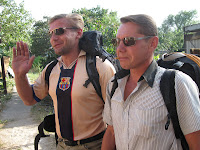
Arriving back at the Kazakhstan border the next day, the only difficulty we seemed to have was that they couldn't identify which country my passport belonged to. It took them a good five minutes to verify that Canada was indeed a country, and that my passport was valid. He he. I guess there aren't HORDES of Canadian tourists storming the borders of Central Asia. I was glad I finally got through, and so were David and Gina.
Okay, I'm going to wind this up now...
My last two weeks out of India were spent in Almaty, teaching for Gina (who ended up having to return to the U.S. on a short-notice family errand). I actually really enjoyed it! Her students were terrific, and it turned out that I wasn't really so awful at English grammer after all. Johanson would have been proud. Stefanovic would have gawked in unbelief! Awe, the good old Greek and Hebrew days. They were indeed terrible!
My last few days in Almaty were spent touring numerous parks, markets, zoos, Soviet monuments, and even a religious site or two. (David and I got to sit in for a wedding at the big Orthodox Cathedral in town. That was definitely cool.) I can see, now, why Gina and David have fallen and stayed in love with Central Asia. Those Grebleys are both so dear to me; now their beloved home lives in my heart, too.

Friday, July 25, 2008
UW- India Group Photo
 I just leaned how to post photos on this thing. Yay! Here is a picture of our UW-India group in front of the Taj. I'll get some more up soon when I make a post about Central Asia.
Wednesday, July 16, 2008
Ultimate Workout- India 2008
Forgive the loooong delay. So much has happened I last wrote. I'll have to go back to retrace my steps. I'm in Kazakhstan now, substitute teaching at an English language institute for a week and a half. Wow! Life is so weird. I'll have to write more about my adventures in both Kazakhstan and Kyrgizstan next time. Below is a little meditation on Maranatha's recent Ultimate Workout India project. For those of you who don't know, UW is short term mission trip designed to challenge teenagers in the areas of spirituality and leadership. It had an enormous impact on me throughout my teen years. I mean, ENORMOUS. Anyway, here's what I wrote for Maranatha's magazine-- it'll help you understand where my heart has been this summer. I don't know what it will look like after they edit and publish it:
We just had an Ultimate Workout. It was rigorous and real: that’s what made it a workout. And it broke even my most wild expectations. After years of advising other fellow Ultimate Workout participants not to box in God with narrow hopes and calculated plans for personal growth, I still find myself falling for the game. God graciously smashed my dreams this year, delivering a truth more lasting—more ultimate—than any short-term spiritual high I could have asked for.
Two days after the project I am left sitting here in an air-conditioned room tracing the face of each participant in the jumbo-glossy group photo we had taken in front of the Taj Mahal. Each teen came with a story and went home with an added chapter unique to their own. 17 year-old ______ signed up from ____ because of her fascination with Indian culture and her desire to make a difference in the lives of others. Recently the idea of studying theology after high school entered her mind. Ultimate Workout gave her the opportunity to think that possibility through in a compelling environment. _______, 18, challenged me with his boyish energy and generous laughter, but most of all, with his genuine pursuit of a loving and compassionate God. ___ hopes to return to India as a school teacher one day.
I will never forget these people, and I don’t think they will soon forget Ultimate Workout-India, either.
Ultimate Workout-India introduced its first annual project last year in Orissa. The target volunteer group has been teens with past mission trip experience—particularly Ultimate Workout experience—and those young people seeking the most intense leadership and spiritual growth opportunities. We came to the project this year with lofty ideals. But by the grace of God, we fast found ourselves confronted with the reality of our human brokenness. The project scope was to help prepare for the opening of the Kadapa Adventist School in Andhra Pradesh, a new facility working closely with a program called Adventist Child India (ACI). ACI provides sponsorships for Adventist village children whose families make less than two dollars a day to come and study as borders at the Kadapa School. Our work for this UW-India had five components: interaction with the children at the school, construction of a wall around the compound, landscaping and beautifying of the campus, sanding of the new 3-child bunk beds for the dormitories, and prayer and visitation in the local villages.
We hit day one hard, mastering the art of block-laying and bogenvelia-bush planting in short order. The teamwork and group camaraderie was terrific and I remember being extremely grateful for the teens God had brought to India this year. But warm fuzzy feelings get stretched on mission trips where the sun shines hot, personalities grate, and unfamiliar living conditions strip away the comfortable borders we build for ourselves at home. One particularly sobering setback came on day three of our project: a wave of the stomach flu washed through our group, knocking two-thirds of the participants down flat on their backs. Discouragement threatened as we watched our newly-planted bogenvelias wither away under the hot sun.
Though undesirable from a human standpoint, these circumstances gave us a hard, honest look at ourselves. We struggled to comprehend how as individuals we deal with discomfort, heat, illness, and the reality of life and death in something as simple as a flowering tree. Sometimes the revelations were disappointing. We found ourselves to be complainers. We were tempted by exhaustion and apathy and the weight of our shattered expectations. Other times found us deeply humbled at what God was able to accomplish even through our limitations. After the sickness passed we made our way back to regroup by the bogenvelias. Brokenness begs teachability, and day by day—through trial and error—we learned how to keep our plants alive. First we regulated our watering times. Next we tried manure. Finally the school children taught us to build little circular walls around the bushes so that they could retain moisture better. The work we did was not grand or earth-shattering, but it was truth-telling in that it required such virtues as patience, discernment, consistency, and faithfulness. For me the plant nursery was a marvelous parable of how we nurture people, indeed, how God nurtured our group bit by bit in spite of our incredible resistance. His hand prevailed.
Generosity is God’s response to our clenched fists. It pours over us whether or not we receive, because it is his initiative. We saw it at work so many times this year. It came through in glorious sunsets watched from rooftops with new friends. It poured from the hearts of villagers who invited us into their homes for prayer and shelter from monsoon rains. The girls on our team slept in the same building as the young students of the Kadapa school. One morning I was feeling particularly grumpy— a trio of girls came up wanting to know if I could remember their names. I was incensed. With hundreds of children swarming the grounds of the Kadapa school, how could they actually expect me to remember each of their names? I brushed past them with obvious annoyance, seeking a room where I could close the door to their pushy demands. But before I could reach such mock security I was ambushed by twenty little girls who pulled my bewildered face down to their level and showered me with kisses.
The holiness of these moments pressed upon me with final clarity during the last Friday night worship our group shared together. We organized a communion service and decorated a rooftop with candles for special ambiance. But that evening was particularly windy, and even our best efforts couldn’t stop the lights from blowing out. We were angry and disappointed until we looked up into the night sky and saw the stars. They shone much greater and more luminous than the silly wax candles we were trying so hard to keep lit. God must have been laughing.
Looking back now, again, on the faces of this year’s participants, I am filled with wonder and gratitude over the joy that is available to those who recognize their inadequacy. Hardships invite broken people to stop and recognize the active and unchanging presence of God in all circumstances. This is the greatness of our weakness—the kind we boast in. And I do boast now, two days after this UW- India. I boast in the God of surprises—the God who showed us the truth that he is greater than our weakness. Indeed, it is in our weak places that he is most strong.
Monday, May 26, 2008
A monkey!
So, the night before last I woke up at about 2:00am with a weight on my body and the feeling that some living thing was very close by. I lifted my head slowly and saw, to my astonishment, a huge monkey perched comfortably on my leg. No joke! He was just chilling there, like I was some random tree limb. The little bugger was pawing through my bag and nearly made off with my ipod. Apparently someone left a window open somewhere.
Saturday, May 24, 2008
Varanasi
Well, I suppose it's time I post a more substantial update here.
I am still in Varanasi having a very nice time, despite the unrelenting heat. Hot Walla Walla summers can be endured thanks to expensive conveniences like air conditioning. But I have yet to find such lovely luxury devices here in Varanasi!
Varanasi is a very ancient city, with centuries-old buildings all crammed up against each other. A network of narrow alleyways weaves this way and that throughout the old city, each somehow connecting to another and another that eventually takes you either to the main road or to the ghats (bathing steps on the banks of the River Ganges). If you've read my India blogs before then you'll have already heard more than enough about the layout and history of Varanasi. It's enough for newcomers here to share that Varanasi is the holiest site in India for Hindu pilgrims. Traditionally it is believed that dying in Varanasi achieves for the deceased automatic release from the oppressive cycle of rebirth. I am staying on the rooftop of Shanti (Peace) Guesthouse, a short step from Manikarnika Ghat (the main cremation site in Varanasi). Here the dead are wrapped in linen and garlands and doused with river water before they are burned in full public view. I am often interrupted in my goings through the streets by a family entourage bearing the body of someone destined for Manikarnika, and I can almost always catch the scent of burning ash in the air. Cremations at Manikarnika happen 24 hours a day. Occasionally I can also see corpses floating down the river unburned (animals, children under 13, pregnant women, sadhus, lepers, and those killed by cobra bites are not cremated for various reasons having to do with purification). Certainly no one can have any illusions about death in this city!
I've met lots of interesting people in Varanasi already-- tourists from Poland, Finland, The Netherlands, Germany, Japan, Brazil, Sweden, and the U.K. One Dutch girl staying in my dorm road her bicycle from The Netherlands all the way to Kathmandu and then bought a motorbike and toured Rajasthan before returning to Kathmandu and cycling down to Varanasi. Now she is trying to find a man with a little boat who will take her all the way to Kolkata (a two week journey down the Ganges). I was tempted to join her until I asked around and learned that some notorious guerrilla groups camp along the shore line in Bihar. I figured I'd best think of something fun to do that is not also potentially deadly. The Dutch girl is also now faltering on the idea and is looking into cycling to Kolkata. You can check out her amazing blog at: www.cyclingdutchgirl.waarbenjij.nu
Even if taking the boat was possible, I probably wouldn't have time. I've been busy here in Varanasi learning tabla and teaching some guitar to my tabla teacher's son. They are a wonderful family-- Lala, Biba, and their two boys. I met Lala through some other tourists when I was in Dharamsala (my first trip to India), and took a few tabla lessons then. Now he and his wife have opened their (minuscule) home to me. They invite me for meals and conversation all the time and they continue to expand my understanding of Hindu culture. Lala's father was a professional Brahmin priest by trade, and the family is very devout. Next week Biba has determined to dress me up like a real Indian woman-- bangles, braids, oiled hair, sari, vermilion powder and all. This will be fun!
Soon I will also start going more regularly to Sarnath, where Amistad sponsors a free school for street children. I'll mostly be interviewing people and writing articles for Amistad's newsletter. I'm lucky in that I'll get some pay for this-- I'm trying to buy some more scarves to sell for school money in the States! Lala helped me locate a silk wholesaler, so that will be extremely helpful.
I am still in Varanasi having a very nice time, despite the unrelenting heat. Hot Walla Walla summers can be endured thanks to expensive conveniences like air conditioning. But I have yet to find such lovely luxury devices here in Varanasi!
Varanasi is a very ancient city, with centuries-old buildings all crammed up against each other. A network of narrow alleyways weaves this way and that throughout the old city, each somehow connecting to another and another that eventually takes you either to the main road or to the ghats (bathing steps on the banks of the River Ganges). If you've read my India blogs before then you'll have already heard more than enough about the layout and history of Varanasi. It's enough for newcomers here to share that Varanasi is the holiest site in India for Hindu pilgrims. Traditionally it is believed that dying in Varanasi achieves for the deceased automatic release from the oppressive cycle of rebirth. I am staying on the rooftop of Shanti (Peace) Guesthouse, a short step from Manikarnika Ghat (the main cremation site in Varanasi). Here the dead are wrapped in linen and garlands and doused with river water before they are burned in full public view. I am often interrupted in my goings through the streets by a family entourage bearing the body of someone destined for Manikarnika, and I can almost always catch the scent of burning ash in the air. Cremations at Manikarnika happen 24 hours a day. Occasionally I can also see corpses floating down the river unburned (animals, children under 13, pregnant women, sadhus, lepers, and those killed by cobra bites are not cremated for various reasons having to do with purification). Certainly no one can have any illusions about death in this city!
I've met lots of interesting people in Varanasi already-- tourists from Poland, Finland, The Netherlands, Germany, Japan, Brazil, Sweden, and the U.K. One Dutch girl staying in my dorm road her bicycle from The Netherlands all the way to Kathmandu and then bought a motorbike and toured Rajasthan before returning to Kathmandu and cycling down to Varanasi. Now she is trying to find a man with a little boat who will take her all the way to Kolkata (a two week journey down the Ganges). I was tempted to join her until I asked around and learned that some notorious guerrilla groups camp along the shore line in Bihar. I figured I'd best think of something fun to do that is not also potentially deadly. The Dutch girl is also now faltering on the idea and is looking into cycling to Kolkata. You can check out her amazing blog at: www.cyclingdutchgirl.waarbenjij.nu
Even if taking the boat was possible, I probably wouldn't have time. I've been busy here in Varanasi learning tabla and teaching some guitar to my tabla teacher's son. They are a wonderful family-- Lala, Biba, and their two boys. I met Lala through some other tourists when I was in Dharamsala (my first trip to India), and took a few tabla lessons then. Now he and his wife have opened their (minuscule) home to me. They invite me for meals and conversation all the time and they continue to expand my understanding of Hindu culture. Lala's father was a professional Brahmin priest by trade, and the family is very devout. Next week Biba has determined to dress me up like a real Indian woman-- bangles, braids, oiled hair, sari, vermilion powder and all. This will be fun!
Soon I will also start going more regularly to Sarnath, where Amistad sponsors a free school for street children. I'll mostly be interviewing people and writing articles for Amistad's newsletter. I'm lucky in that I'll get some pay for this-- I'm trying to buy some more scarves to sell for school money in the States! Lala helped me locate a silk wholesaler, so that will be extremely helpful.
Wednesday, May 14, 2008
Arrived
Last Thursday:
Well, I finally made it!
I arrived in Delhi this afternoon after a long trans-Pacific flight. It's pretty warm here this time of year, and it's hard for me to imagine that only yesterday I was cross-country skiing through the foothills of whatever mountains are near Snohomish. (Yes, it was fun. But I must have fallen at least twenty times and my butt still hurts!)
I had a stopover in Taipei and that was kind of sentimental-- I flew through Taipei (and nearly every other world city) on my first trip to India. This time I especially appreciated the enormous signs in each terminal that said "Drug trafficking is punishable by death in the R.O.C. (Republic of China). Excellent.
Upon arrival in Delhi I caught a taxi to Pahar Ganj, which is the main backpacker district in Delhi. In the middle of our silent and peaceful drive, my driver looked me in the rear-view mirror and asked if sex was easy in "my country." Great, it starts. Through broken English I tried to explain to him about Hollywood and the illusions supported by Western media in India. Whatever. He was kind of right, wasn't he? But I didn't tell him so.
Once in Pahar Ganj I coughed up Rs200 ($5) for a room because I was too tired to keep in pursuit of a cheaper dormitory bed. The room is really nice, except for the weird bugs all over the walls of the bathroom. It has a balcony, making it possibly for me to spy on passersby on the congested street below. You know, I think this sort of activity is actually my favorite thing to do in India. Its amazing what you see when no one knows you are watching.
I had my first meal at the same restaurant where I ate my last meal, last time I was in India. I couldn't believe I stumbled on the same place! The paneer butter masala was great, and it was fun relearning how to avoid accosting street venders on my way back to the hotel. My feet did get run over by a cycle rickshaw already. That kind of hurt.
May 18 (today).
I better post this. I had noble aspirations of adding some "very profound thoughts" (see me rolling my eyes), but it just isn't going to happen right now. Too much to do in this wonderful, marvelous city called Varanasi (yes, that's where I am now). I will probably stick to short, interesting travel updates over soul-wrenching monologues for the next couple months. Or maybe I will change my mood tomorrow. Who really does know?!
Well, I finally made it!
I arrived in Delhi this afternoon after a long trans-Pacific flight. It's pretty warm here this time of year, and it's hard for me to imagine that only yesterday I was cross-country skiing through the foothills of whatever mountains are near Snohomish. (Yes, it was fun. But I must have fallen at least twenty times and my butt still hurts!)
I had a stopover in Taipei and that was kind of sentimental-- I flew through Taipei (and nearly every other world city) on my first trip to India. This time I especially appreciated the enormous signs in each terminal that said "Drug trafficking is punishable by death in the R.O.C. (Republic of China). Excellent.
Upon arrival in Delhi I caught a taxi to Pahar Ganj, which is the main backpacker district in Delhi. In the middle of our silent and peaceful drive, my driver looked me in the rear-view mirror and asked if sex was easy in "my country." Great, it starts. Through broken English I tried to explain to him about Hollywood and the illusions supported by Western media in India. Whatever. He was kind of right, wasn't he? But I didn't tell him so.
Once in Pahar Ganj I coughed up Rs200 ($5) for a room because I was too tired to keep in pursuit of a cheaper dormitory bed. The room is really nice, except for the weird bugs all over the walls of the bathroom. It has a balcony, making it possibly for me to spy on passersby on the congested street below. You know, I think this sort of activity is actually my favorite thing to do in India. Its amazing what you see when no one knows you are watching.
I had my first meal at the same restaurant where I ate my last meal, last time I was in India. I couldn't believe I stumbled on the same place! The paneer butter masala was great, and it was fun relearning how to avoid accosting street venders on my way back to the hotel. My feet did get run over by a cycle rickshaw already. That kind of hurt.
May 18 (today).
I better post this. I had noble aspirations of adding some "very profound thoughts" (see me rolling my eyes), but it just isn't going to happen right now. Too much to do in this wonderful, marvelous city called Varanasi (yes, that's where I am now). I will probably stick to short, interesting travel updates over soul-wrenching monologues for the next couple months. Or maybe I will change my mood tomorrow. Who really does know?!
Saturday, May 3, 2008
The Shame of Being Called
Well, it looks like my first "pastoral" post is coming to a close. It was much different then I expected. When God said "be a pastor," I suspected it would be hard, but I had no idea it would be this personal or painful. I had no idea I would do it this poorly. But that's okay.
I'm leaving for India on Wednesday and will stay in Varanasi for a month (probably) before making a brief pilgrimage back to Darjeeling. After that its UW in Andhra Pradesh, and then off to Kazakhstan, Kyrgystan, and perhaps China with Gina and David. I'll end my trip with a month of blessed aloneness in Kolkata.
I am uncertain about what will come after that. Currently I am registered to begin an MA program at Regent College in Vancouver, B.C., but I think I may switch over to the MDiv instead. It will be more versitile, and it will probably take the same amount of time as the MA would have. I keep asking myself why I don't just go to Andrews if I'm going to do the MDiv anyway-- its free there, after all! I argue back that I have chosen Regent for a number of reasons: 1. To be close to my family at this very critical time. 2. To be close to Natalie. 3. For a superior education. 4. So I can explore the larger Christian world.
I don't think I believe in sectarianism. I believe strongly that we Adventists must humbly find our place in the Christian church if we are to have any voice that matters at all. We have a great deal to offer and a great deal to learn, but neither of those things can happen if we continue to isolate ourselves.
Of course, going to Regent will likely limit my opportunities for ministry within the Adventist church (as if I needed any more strikes against me. I'm already a female, a first-generation Adventist, a graduate of an institution some people view with suspicion, and a person who thinks outside the box. I'm done for.) Perhaps I truly am destined to become a wandering, restless nomad.
It occured to me recently that maybe my expectations were all wrong about what God would call me to when I resolved to obey him. I thought pastoral ministry meant he would call me to a church and give me a little apartment with a little car and some stability. Perhaps I felt sorry for myself for the wandering I did as a child, and thought God did too. I fancied he would finally give me an earthly home. (How do we manage to convince ourselves that even GOD wants what we want?) Could it be that all my years of wandering were instead preperation for a life that will keep ON wandering? Maybe this IS my calling. Gulliver. Rachel the Vagabond. It makes sense.
I'm ashamed of myself over this whole pastoral business. I was so proud, thinking I finally "gave in" to God's calling. I see now that maybe the only thing I gave in to was the part I understood. All my life God has led me closely. Every unfolding event was ordained and directed, clear and sure. As early as five I knew who I was and where I was going. At nine it was "certain" I would be a cloistered nun (I already had the whole landscape of my convent mapped out in my mind.) But God is no longer allowing me to charge ahead in certainty. He is just saying "Wait. Notice this about yoursef? You're not ready yet, despite what you think. Stop playing guessing games-- your calling is me and you are only special in my love. " There are so many ways in which I still need to grow up. I feel very much like Bree, the talking horse from "The Horse and His Boy," who discovered that in Narnia he was really quite an average beast after all. Only in his small world of slavery was he braver and more clever than the other horses.
Perhaps the last word on this subject is that it is really not my right to set myself up anywhere. It isn't mine to refuse OR to demand a place in God's service. My only right, as Christian, is to belong to God and to do as he instructs regardless of the cost or glory. I wish my heart could understand this.
I'm leaving for India on Wednesday and will stay in Varanasi for a month (probably) before making a brief pilgrimage back to Darjeeling. After that its UW in Andhra Pradesh, and then off to Kazakhstan, Kyrgystan, and perhaps China with Gina and David. I'll end my trip with a month of blessed aloneness in Kolkata.
I am uncertain about what will come after that. Currently I am registered to begin an MA program at Regent College in Vancouver, B.C., but I think I may switch over to the MDiv instead. It will be more versitile, and it will probably take the same amount of time as the MA would have. I keep asking myself why I don't just go to Andrews if I'm going to do the MDiv anyway-- its free there, after all! I argue back that I have chosen Regent for a number of reasons: 1. To be close to my family at this very critical time. 2. To be close to Natalie. 3. For a superior education. 4. So I can explore the larger Christian world.
I don't think I believe in sectarianism. I believe strongly that we Adventists must humbly find our place in the Christian church if we are to have any voice that matters at all. We have a great deal to offer and a great deal to learn, but neither of those things can happen if we continue to isolate ourselves.
Of course, going to Regent will likely limit my opportunities for ministry within the Adventist church (as if I needed any more strikes against me. I'm already a female, a first-generation Adventist, a graduate of an institution some people view with suspicion, and a person who thinks outside the box. I'm done for.) Perhaps I truly am destined to become a wandering, restless nomad.
It occured to me recently that maybe my expectations were all wrong about what God would call me to when I resolved to obey him. I thought pastoral ministry meant he would call me to a church and give me a little apartment with a little car and some stability. Perhaps I felt sorry for myself for the wandering I did as a child, and thought God did too. I fancied he would finally give me an earthly home. (How do we manage to convince ourselves that even GOD wants what we want?) Could it be that all my years of wandering were instead preperation for a life that will keep ON wandering? Maybe this IS my calling. Gulliver. Rachel the Vagabond. It makes sense.
I'm ashamed of myself over this whole pastoral business. I was so proud, thinking I finally "gave in" to God's calling. I see now that maybe the only thing I gave in to was the part I understood. All my life God has led me closely. Every unfolding event was ordained and directed, clear and sure. As early as five I knew who I was and where I was going. At nine it was "certain" I would be a cloistered nun (I already had the whole landscape of my convent mapped out in my mind.) But God is no longer allowing me to charge ahead in certainty. He is just saying "Wait. Notice this about yoursef? You're not ready yet, despite what you think. Stop playing guessing games-- your calling is me and you are only special in my love. " There are so many ways in which I still need to grow up. I feel very much like Bree, the talking horse from "The Horse and His Boy," who discovered that in Narnia he was really quite an average beast after all. Only in his small world of slavery was he braver and more clever than the other horses.
Perhaps the last word on this subject is that it is really not my right to set myself up anywhere. It isn't mine to refuse OR to demand a place in God's service. My only right, as Christian, is to belong to God and to do as he instructs regardless of the cost or glory. I wish my heart could understand this.
Wednesday, April 30, 2008
A Frustrating Speaking Experience
Don't worry, I'm back. I haven't drowned in the sea. I went to Hawaii and spent as little time as possible on my computer. One day soon I may write about the Dalai Lama, but it won't be tonight. I'm too tired.
Still jet-lagged, I woke up early this morning and drove 2.5 hours to speak at an academy about New Light (a home for the children of sex workers in India), and about how the Gospel compels Christians to engage in issues of social justice. It was an extremely disheartening experience. First, I spent $70 to get there and back in my family's gas-guzzeling behemoth vehicle. Then when I got there, I found that the person who'd invited me had been called away on an emergency. (I should add that it was a very valid emergency.) A student worker greeted me timidly on his behalf, took my DVD, and disappeared to have it set up. After getting lost, I found the gathering myself and forged my way into a room full of rowdy students who looked like they would rather be anywhere else besides a chapel program. A smily-looking lady shook my hand and then introduced me to the students, telling them (with evident dis-ease) that I would be sharing some "perhaps uncomfortable" things about my "work" in India. I was highly amused. I don't think she was entirely pleased with my presence.
When I got up to begin I was immediately intimidated. (I am extremely crowd sensitive.) During preaching assignments at a certain county church near WWU, I used to stutter all over my sermons because of a bald man who always snored in the middle left-hand pew. But despite snickering and whispering and paper-ball throwing (that was probably only in my imagination), I did a decent job at the academy. I was enthusiastic and clear of speach, and what I had to say was (I thought) extremely relevant. But most of my audience was not engaged. I tried hard to reach them, even bursting out of my notes from time to time (a nearly unheard of event for Gulliver). It was hopeless. But for a very few, they would not be drawn in.
I suppose in the end I can't really blame the students. I am a much more effective "high church" preacher, however much I dream of spouting off the cuff, firey, and entertaining sermons. I never raise my voice or wave my arms. I wouldn't dream of budging from the podium. I tend to read my manuscripts, which are carefully crafted and technical (often mediocre) theological expositions. For better or for worse, this stuff tends to go over well in preaching class and in traditional church settings, but it didn't work with the kids. They weren't interested in my "brilliant" manifesto for a Christian spirituality that generates acts of compassion. It was perhaps too esoteric.
The smily lady came and sat nearby while the DVD played, so I leaned over and asked her how much time I had left to wrap things up. She said I had about 10 minutes, but advised me to keep it shorter. "This is heavy stuff for these kids," she said (sounding slightly offended). Yes, child prostitution is heavy for kids. Much too heavy. That's exactly why we must talk about it.
I'm afraid I really let her words crush my spirit. I ended my presentation by challenging the students to cultivate a holistic spirituality that engages mind, body, and soul. I told them that the Kingdom of God "out there" is really "here, now," that it has burst forth in our midst, and that disciples of Christ must therefore be voices of justice and peace. Then do you know what happened? The whole mob jumped and ran for the door. It was lunch time.
I had just told them about starving babies, and they were still concerned about lunch! Perhaps it was a painful rebuke of my own appetite, or perhaps it was righteous (or self-righteous) indignation. But whatever the case, it made me feel very sad.
Finding nothing to do in the empty chapel after everyone left, I simply shrugged, went to the car, and drove home. I felt like I had waisted both my time and my money, and I felt frustrated with myself and with what I judged to be superficiality on the part of the students. I don't know why God keeps putting teenagers in my life-- they are absolutely infuriating. God only knows why I like them and why they like me (and they do, even when they don't get my speaking. Its really weird.)
Okay, I must go to sleep now. I feel sick with sleepiness. This entry was obviously not meant to provoke any profound thoughts, but only to appease those friends who have been prodding me for a blog update.
Good night.
Still jet-lagged, I woke up early this morning and drove 2.5 hours to speak at an academy about New Light (a home for the children of sex workers in India), and about how the Gospel compels Christians to engage in issues of social justice. It was an extremely disheartening experience. First, I spent $70 to get there and back in my family's gas-guzzeling behemoth vehicle. Then when I got there, I found that the person who'd invited me had been called away on an emergency. (I should add that it was a very valid emergency.) A student worker greeted me timidly on his behalf, took my DVD, and disappeared to have it set up. After getting lost, I found the gathering myself and forged my way into a room full of rowdy students who looked like they would rather be anywhere else besides a chapel program. A smily-looking lady shook my hand and then introduced me to the students, telling them (with evident dis-ease) that I would be sharing some "perhaps uncomfortable" things about my "work" in India. I was highly amused. I don't think she was entirely pleased with my presence.
When I got up to begin I was immediately intimidated. (I am extremely crowd sensitive.) During preaching assignments at a certain county church near WWU, I used to stutter all over my sermons because of a bald man who always snored in the middle left-hand pew. But despite snickering and whispering and paper-ball throwing (that was probably only in my imagination), I did a decent job at the academy. I was enthusiastic and clear of speach, and what I had to say was (I thought) extremely relevant. But most of my audience was not engaged. I tried hard to reach them, even bursting out of my notes from time to time (a nearly unheard of event for Gulliver). It was hopeless. But for a very few, they would not be drawn in.
I suppose in the end I can't really blame the students. I am a much more effective "high church" preacher, however much I dream of spouting off the cuff, firey, and entertaining sermons. I never raise my voice or wave my arms. I wouldn't dream of budging from the podium. I tend to read my manuscripts, which are carefully crafted and technical (often mediocre) theological expositions. For better or for worse, this stuff tends to go over well in preaching class and in traditional church settings, but it didn't work with the kids. They weren't interested in my "brilliant" manifesto for a Christian spirituality that generates acts of compassion. It was perhaps too esoteric.
The smily lady came and sat nearby while the DVD played, so I leaned over and asked her how much time I had left to wrap things up. She said I had about 10 minutes, but advised me to keep it shorter. "This is heavy stuff for these kids," she said (sounding slightly offended). Yes, child prostitution is heavy for kids. Much too heavy. That's exactly why we must talk about it.
I'm afraid I really let her words crush my spirit. I ended my presentation by challenging the students to cultivate a holistic spirituality that engages mind, body, and soul. I told them that the Kingdom of God "out there" is really "here, now," that it has burst forth in our midst, and that disciples of Christ must therefore be voices of justice and peace. Then do you know what happened? The whole mob jumped and ran for the door. It was lunch time.
I had just told them about starving babies, and they were still concerned about lunch! Perhaps it was a painful rebuke of my own appetite, or perhaps it was righteous (or self-righteous) indignation. But whatever the case, it made me feel very sad.
Finding nothing to do in the empty chapel after everyone left, I simply shrugged, went to the car, and drove home. I felt like I had waisted both my time and my money, and I felt frustrated with myself and with what I judged to be superficiality on the part of the students. I don't know why God keeps putting teenagers in my life-- they are absolutely infuriating. God only knows why I like them and why they like me (and they do, even when they don't get my speaking. Its really weird.)
Okay, I must go to sleep now. I feel sick with sleepiness. This entry was obviously not meant to provoke any profound thoughts, but only to appease those friends who have been prodding me for a blog update.
Good night.
Monday, April 14, 2008
Greed
I astonish myself with my own greed. Today at the SeaTac airport I got a meal voucher because of a delayed flight. I wasn't hungry at all, and it occured to me that maybe I should seek out some more needy soul to give it to (like, maybe a stranded parent with children). But did I do it? No! I went to a restaurant I didn't like and bought a sandwhich I didn't want, all because I couldn't stand the thought of forgoing free food. Why are we such gluttans? Why can't we be content with flat, satisfied stomachs? Why must we greedily cash in on every opportunity for "more"?
I feel sick now. Overstuffed.
I have lots to write, its true. I flatter myself that some of you are waiting breathlessly for my reflections on the Dalai Lama, but more likely I am the one who most enjoys my monologues. Oh, God bless us pitiful creatures. As soon as I find a few moments to breathe I will write a full update on the recent happenings of my life. Too much to do.
I came across a quote last night that I really, really liked. Its attributed to Mother Teresa, but it doesn't sound like her voice to me (I should know. Right.) Here it is:
"We the unwilling, led by the unknown, have been doing the impossible for the ungrateful. We have done so much for so long with so little, that we are now qualified to do anything with nothing."
I feel sick now. Overstuffed.
I have lots to write, its true. I flatter myself that some of you are waiting breathlessly for my reflections on the Dalai Lama, but more likely I am the one who most enjoys my monologues. Oh, God bless us pitiful creatures. As soon as I find a few moments to breathe I will write a full update on the recent happenings of my life. Too much to do.
I came across a quote last night that I really, really liked. Its attributed to Mother Teresa, but it doesn't sound like her voice to me (I should know. Right.) Here it is:
"We the unwilling, led by the unknown, have been doing the impossible for the ungrateful. We have done so much for so long with so little, that we are now qualified to do anything with nothing."
Friday, April 4, 2008
Hello Dalai Lama!
Guess what, guess what? I am going to see the Dalai Lama next week! Yay!!! I can hardly believe my good fortune on this one. The downstairs tenant in our house is a fabulous woman-- so intuitive and kindhearted. We live on an Indian reservation, and Sheryl works part time at the tribal center where Native American artists have been busily beading, crocheting, and quilting quilts for the Dalai Lama and his entourage. "His Holiness" (as all my friends in Kolkata liked to call him) will be hosting a very special meeting on the 13th just for the Native American people of our region.
Well, when Sheryl mentioned last week that the DL was coming to town for this program, I just about flipped! I wanted to go! I did a quick search and found out that the whole event (Seeds of Compassion) was actually being held in Seattle, and that there was a public gathering scheduled for the 12th. I was shocked and scandalized to learn that there were NO MORE TICKETS available, and that therefore I would not be able to attend. Dear Sheryl made note of my disappointment and without telling me, contacted her friend at the tribal center who is organizing the April 13 event. To make a long story short, I HAVE A TICKET NOW!!! I have a ticket to hear the Dalai Lama speak on the 12th about Compassion in Action, particularly on how we can nurture compassion in the hearts and minds of children. I am extremely excited. It will be at the Qwest Field, and nearly 40,000 people are expected to attend. That figure makes me feel a little dizzy, but it will be worth the crowd for this experience!
Today I had a wonderful time down at the beach. I tried Lectio Devina for the first time (I've done it "informally" before, sure. This is just the first time I've ever given it a fancy Latin title). Anyway, I wanted to experiment with some of the spiritual practices prescribed in the Campolo/Darling book. Since Darling said it was not good to worry too much about picking "just the right text," I just opened my Bible and picked the first line that struck me. It said, from 2 Corinthians 12:14, "I seek not what is yours, but you."
As I thought about this line, what emerged was the liberating sense that God is not particularly interested in what I have or don't have to give him in service. What he's concerned about is having me-- all of me-- me and only me. Once I am his he can do with me whatever he pleases. If I am found useful for some high-profile place of service, then there he will put me. If I'm found more suitable elsewhere, then elsewhere I will go. The bottom line is that I am his-- not my stuff, not my "gifts." He can make doers out of rocks if he wishes. Its my love that he wants. And love is a gift that no one is left unable to give. Maybe I can't sing, dance, preach, write, or inspire others, but I can always love. Love is the one and only gift that a creature can actually give to God. And in the end, loving is the way we give our whole selves.
Okay, to bed I go. Tonight I will dream of incense and saffron robes. What a lovely day!
Well, when Sheryl mentioned last week that the DL was coming to town for this program, I just about flipped! I wanted to go! I did a quick search and found out that the whole event (Seeds of Compassion) was actually being held in Seattle, and that there was a public gathering scheduled for the 12th. I was shocked and scandalized to learn that there were NO MORE TICKETS available, and that therefore I would not be able to attend. Dear Sheryl made note of my disappointment and without telling me, contacted her friend at the tribal center who is organizing the April 13 event. To make a long story short, I HAVE A TICKET NOW!!! I have a ticket to hear the Dalai Lama speak on the 12th about Compassion in Action, particularly on how we can nurture compassion in the hearts and minds of children. I am extremely excited. It will be at the Qwest Field, and nearly 40,000 people are expected to attend. That figure makes me feel a little dizzy, but it will be worth the crowd for this experience!
Today I had a wonderful time down at the beach. I tried Lectio Devina for the first time (I've done it "informally" before, sure. This is just the first time I've ever given it a fancy Latin title). Anyway, I wanted to experiment with some of the spiritual practices prescribed in the Campolo/Darling book. Since Darling said it was not good to worry too much about picking "just the right text," I just opened my Bible and picked the first line that struck me. It said, from 2 Corinthians 12:14, "I seek not what is yours, but you."
As I thought about this line, what emerged was the liberating sense that God is not particularly interested in what I have or don't have to give him in service. What he's concerned about is having me-- all of me-- me and only me. Once I am his he can do with me whatever he pleases. If I am found useful for some high-profile place of service, then there he will put me. If I'm found more suitable elsewhere, then elsewhere I will go. The bottom line is that I am his-- not my stuff, not my "gifts." He can make doers out of rocks if he wishes. Its my love that he wants. And love is a gift that no one is left unable to give. Maybe I can't sing, dance, preach, write, or inspire others, but I can always love. Love is the one and only gift that a creature can actually give to God. And in the end, loving is the way we give our whole selves.
Okay, to bed I go. Tonight I will dream of incense and saffron robes. What a lovely day!
Thursday, April 3, 2008
Landscapes
What I'm doing in life right now is the hardest thing I've ever done (besides VGA). Harder than Kolkata. Harder than UW. Those other things may have felt just as hard or even harder, but that's only because I had less spiritual tools to work with at the time. Its encouraging to remind myself that I never would have survived even one week in my current situation prior to this year. Its a good thing we grow.
It is remarkable how easily we are influenced by the thoughts, words, and lifestyles of others. And it is disappointing to realize how very vulnerable and weak we are in the face of all this. For so long I was convinced that if I could only choose belief, then I would be unstoppable. I was sure (though I never would have admitted it) that I had all the wisdom and skill necessary for ministry. All I lacked was the will and the heart.
In the months preceding this new "vocation" of mine, these certainties were exactly reversed. After L'Abri and Taize I had a deep desire to touch people with compassion (it burned in me). I loved and yearned for people in a way I hadn't experienced since my conversion. But I also had a new and strange distrust of my ability. If I found myself tongue-tied pre-Europe, post-Europe found my feet and hands tied instead. It was all about waiting, waiting, waiting for the opportunity. Waiting for my call. Waiting for God's "go ahead."
I had a lot of hope for the Corinthian texts: "My strength is made perfect in weakness...," "God has chosen the weak things...," etc. I held to the old quip, "God does not call the qualified, but qualifies the called." Well, now that all of me is unstuck (tongue, hands, and feet,) something is still not quite right. Why am I still not conquering the world? After all, I'm not waiting for anything anymore. I am completely free in my faith, in my adulthood, and in my calling. So why do I still get lazy? Why am I still powerless over my gluttony? Why fearful? (So, so fearful.) Why undisciplined? Unloving? Sometimes depressed?
And why, with my new "commitment" to obedience, did God have to first send me to this most difficult post of all? When it makes me tremble with doubt, when it draws out even my deepest, most hidden fears, why does he leave me in this space? When will I ever be able to move past myself so that life can be less about me and more about others?
Who am I blessing right now? How is this "ministry"?
I am so afraid of going back to what was, of loosing my joy and my New Life. What happened in Europe gave me so much hope. It filled my life with wonder, such promise, and so much love. I felt energized and alive in a way I'd nearly given up on ever feeling again. Forgive me for beating this thing to death: tender, whole, deliberate, and so, so deeply beautiful... that's how it was. How can one-time children of Light settle for this New Age pandering of Yin and Yang and the acceptance of a death called "balance"? Oh, there is indeed a very healthy form of death, I know. And though I've struggled to welcome it, I have at least now let it in the front door of my heart. But this Christian kind of death is meant as the passage to Eternal Life. Can shadows of the spiritual life really serve this end? Oh, what am I thinking? Of course they can! They always have. In the life of every saint, in creation, in the history of God, they have. Why does this truth keep elluding me?
As I sit here on the couch I am gazing through the window at the ocean. A few days ago I discovered a secret trail leading down through a neighbor's yard towards the beach. Most everyone I know will be appalled to learn how unenthusiastic I usually am about the sea. I'm sorry about that. Truth be told, I've never really been a "beachy" kind of girl. I prefer wheat fields to run in, and the ever-present sky with its lights and stars and sun. Recently I heard about a book that parallels landscapes with our spiritual journeys (no, I haven't read the book yet). This was not a new idea to me. It is clear why I like the wild freedom of these open spaces. God has always spoken to me through their gold: gold beams streaming through golden clouds on golden fields. And all of this moving, rolling on, forever.
Unfortunately, during times of spiritual dryness I have at times approached God brazenly in these, his symbols. I have raged at sunsets and worn ugly yellows, as if somehow I could induce God's presence in my life. In Kolkata I finally learned to accept Absence (thank you, Mother Teresa and Martin Marty). Like the quail-stuffed children of Israel on their way to the Promised Land, I finally got sick from my impetuous spiritual appetite. "God sent leanness" just in time, and thereafter I experienced a period of much needed "winterfallow." (Check out Marty's book, "A Cry of Absence," and you'll pick up my allusions-- if you haven't already.)
In Kolkata I learned to accept the greyness. The external imagery of the place matched perfectly the way I felt inside: smoggy, dead, and numbed with noise. By the time I arrived back in the United States I could hardly stand to look at a sunset. (Was it shame? Embarrassment? Disappointment?) What I felt, distinctly, was that sunsets were somehow just too rich for my new spiritual diet.
Coming to the west side, now, I am finding myself confronted with a new spiritual scape in the sea. I actually enjoyed myself at the beach this week. Immensely. The tide was out and the cold grey rocks were draped in green seaweed. Smooth sandbars sunk beneath my feet and disappeared beneath water. I watched seagulls; I stuck my fingers into giant barnacles and hopped over driftwood. And most beautiful of all? As I stood gazing into the distance I finally saw the setting sun as a brand new gift. It did not come to me streaming over summer wheat fields. It came in stillness, trembling over little golden waves.
And this was the great grey sea.
It is remarkable how easily we are influenced by the thoughts, words, and lifestyles of others. And it is disappointing to realize how very vulnerable and weak we are in the face of all this. For so long I was convinced that if I could only choose belief, then I would be unstoppable. I was sure (though I never would have admitted it) that I had all the wisdom and skill necessary for ministry. All I lacked was the will and the heart.
In the months preceding this new "vocation" of mine, these certainties were exactly reversed. After L'Abri and Taize I had a deep desire to touch people with compassion (it burned in me). I loved and yearned for people in a way I hadn't experienced since my conversion. But I also had a new and strange distrust of my ability. If I found myself tongue-tied pre-Europe, post-Europe found my feet and hands tied instead. It was all about waiting, waiting, waiting for the opportunity. Waiting for my call. Waiting for God's "go ahead."
I had a lot of hope for the Corinthian texts: "My strength is made perfect in weakness...," "God has chosen the weak things...," etc. I held to the old quip, "God does not call the qualified, but qualifies the called." Well, now that all of me is unstuck (tongue, hands, and feet,) something is still not quite right. Why am I still not conquering the world? After all, I'm not waiting for anything anymore. I am completely free in my faith, in my adulthood, and in my calling. So why do I still get lazy? Why am I still powerless over my gluttony? Why fearful? (So, so fearful.) Why undisciplined? Unloving? Sometimes depressed?
And why, with my new "commitment" to obedience, did God have to first send me to this most difficult post of all? When it makes me tremble with doubt, when it draws out even my deepest, most hidden fears, why does he leave me in this space? When will I ever be able to move past myself so that life can be less about me and more about others?
Who am I blessing right now? How is this "ministry"?
I am so afraid of going back to what was, of loosing my joy and my New Life. What happened in Europe gave me so much hope. It filled my life with wonder, such promise, and so much love. I felt energized and alive in a way I'd nearly given up on ever feeling again. Forgive me for beating this thing to death: tender, whole, deliberate, and so, so deeply beautiful... that's how it was. How can one-time children of Light settle for this New Age pandering of Yin and Yang and the acceptance of a death called "balance"? Oh, there is indeed a very healthy form of death, I know. And though I've struggled to welcome it, I have at least now let it in the front door of my heart. But this Christian kind of death is meant as the passage to Eternal Life. Can shadows of the spiritual life really serve this end? Oh, what am I thinking? Of course they can! They always have. In the life of every saint, in creation, in the history of God, they have. Why does this truth keep elluding me?
As I sit here on the couch I am gazing through the window at the ocean. A few days ago I discovered a secret trail leading down through a neighbor's yard towards the beach. Most everyone I know will be appalled to learn how unenthusiastic I usually am about the sea. I'm sorry about that. Truth be told, I've never really been a "beachy" kind of girl. I prefer wheat fields to run in, and the ever-present sky with its lights and stars and sun. Recently I heard about a book that parallels landscapes with our spiritual journeys (no, I haven't read the book yet). This was not a new idea to me. It is clear why I like the wild freedom of these open spaces. God has always spoken to me through their gold: gold beams streaming through golden clouds on golden fields. And all of this moving, rolling on, forever.
Unfortunately, during times of spiritual dryness I have at times approached God brazenly in these, his symbols. I have raged at sunsets and worn ugly yellows, as if somehow I could induce God's presence in my life. In Kolkata I finally learned to accept Absence (thank you, Mother Teresa and Martin Marty). Like the quail-stuffed children of Israel on their way to the Promised Land, I finally got sick from my impetuous spiritual appetite. "God sent leanness" just in time, and thereafter I experienced a period of much needed "winterfallow." (Check out Marty's book, "A Cry of Absence," and you'll pick up my allusions-- if you haven't already.)
In Kolkata I learned to accept the greyness. The external imagery of the place matched perfectly the way I felt inside: smoggy, dead, and numbed with noise. By the time I arrived back in the United States I could hardly stand to look at a sunset. (Was it shame? Embarrassment? Disappointment?) What I felt, distinctly, was that sunsets were somehow just too rich for my new spiritual diet.
Coming to the west side, now, I am finding myself confronted with a new spiritual scape in the sea. I actually enjoyed myself at the beach this week. Immensely. The tide was out and the cold grey rocks were draped in green seaweed. Smooth sandbars sunk beneath my feet and disappeared beneath water. I watched seagulls; I stuck my fingers into giant barnacles and hopped over driftwood. And most beautiful of all? As I stood gazing into the distance I finally saw the setting sun as a brand new gift. It did not come to me streaming over summer wheat fields. It came in stillness, trembling over little golden waves.
And this was the great grey sea.
Sunday, March 30, 2008
Jealousy in the Spiritual Life
For the last few days I have been experiencing a strange emotion. Its a Kolkata feeling. Its jealousy.
I was barely in my teens when I had my first very vivid encounter with the presence of God. It is something I can't and won't try describing here, for it is enough to say that I had it. The fire lasted a year and a half, a time about which I fear I cannot share lest I impinge on the sacred (this is probably in my head, but it is how I feel).
December 14, 1998 began a new period in my spiritual journey-- an eight month stint of intense darkness, feelings of separation, and soul agonizing doubt. I emerged from that experience during the summer of '99 and have spent every minute of my life since trying to make sense of both spiritual poles: presence and absence, friend and enemy, belief and unbelief. Intellectually I continued to struggle with my committed Christian stance for many years, and as time went on it seemed that doubt would never let me love as freely as I once had. After all, the Person I once loved had become a Mystery. How do you love Mystery?
After learning of Mother Teresa's spiritual darkness during my third year in college, I set out for Kolkata to explore this thing further. Actually, I went for three reasons: The first was to learn how to lose myself (still in progress). The second was to explore the concept of community for Christian believers (I was an Adventist. I wondered what it meant to share my Christian identity with Catholics and other Protestants. Also, I wondered what kind of community I could share with unbelievers, Hindus, seculars, and others.) I made some progress in this department, but I still have a ways to go.
My third and most personal reason for going to Kolkata had to do with Mother Teresa's question, my question, and the question of so many others: Is God truly present in this world? Why do we experience absence? I was on a quest for joy, above all. I ached for intimacy with God.
Reflecting back I am certain that Kolkata was indeed a time of intimacy. But it had such a radically different face from my early experience that it felt like desolation. I longed for God with everything in me, but he seemed only distant, even dead.
Then to my amazement, he showed up. He came in power-- with love and grace and all the riches of consolation. But he didn't come for me. Instead he swept into my Kolkata reality and fell on my friend. That's right, my friend.
They were like two young lovers, God and Marie. And I? I felt like the old wife standing by-- no longer cared for, worn and unwanted. Marie's awakening was the most moving conversion I ever witnessed in my life (besides my own), and I watched it with wonder and awe. I was so honestly happy for her.
And so, so jealous.
Now journeying past Kolkata I can say that a fresh well has also sprung up in my spiritual life (a story for another blog). But there have recently been some painful knocks to my connected happiness, especially as I've grown more deeply towards my first Kolkata objective (forgetting self). For years I thought I was special, having once experienced the Living God. But as I have gradually embraced my humanity and deflated in my own eyes, I've discovered that many believers have had such experiences. In fact, most "born again" believers speak wistfully about their first spiritual awakening. This makes me mad!! How do I know mine was not any different from theirs? More frightening than that is the question, "why does it bother me so much to think that others have also 'known' God?" (Why do I want to be God's "only one"?) The truth is that I still want to be special. I'm mourning the death of my pride.
I can really thank Tony Campolo and his contribution to "The God of Intimacy and Action" for bringing this problem to my attention. In the first section of the book he really brings mysticism down to earth for those of us who would prefer to keep it up in the clouds (for the elite). He says mystical experiences are available to all believers. He even categorizes them into "types of mystical experiences" (new insights, I-Thou relationships, times of heightened awareness, conversion experiences, and breakthrough experiences). Reality is alive with God's presence, and we are the variables who tap in or out. I am a variable, and I am too often out. I am not God or the wife of God (no, not a nun indeed!) I am so wretchedly ordinary and spiritually poor that I can hardly stand it.
I want to be all! I want to pray like Mother Teresa, "Let me love you like you have never been loved before!" I want to speak "face to face" with God, intimately, permanently, forever. But when I said "here I am" to God's call, he sent me to the most mundane place. He sent me to restless activity, endless listening, housework, uncertainty, impermanence, loneliness. This does not feel spiritual at all.
Campolo and his co-author (Mary Albert Darling) claim that it is possible to live in a state of constant intimacy with God. If the path I'm on will take me there, then may I never stray. MT's words are so beautiful (though of course I have never suffered like she did): "When You asked to imprint Your passion on my heart, is this the answer? If this brings You glory, if You get a drop of joy from this, if souls are brought to You, if my suffering satiates Your Thirst-- here I am, Lord. With joy I accept all to the end of life and I will smile at Your Hidden Face-- always."
I do still have one question, however. In her discussion on Mother Teresa's "dark night," Carol Zaleski discusses all the forms of darkness and "not knowing" that have taken place down through the centuries of Christendom. Then she ends by quoting John Chapman of the Downside (Benedictine) Abbey. In 1923 he concluded that "In the seventeenth and eighteenth centuries most pious souls seem to have gone through a period in which they felt sure that God had reprobated them... This doesn't seem to happen nowadays. But the corresponding trial of our contemporaries seems to be the feeling of not having any faith; not temptations against any particular article, but a mere feeling that religion is not true."
This comment was particularly striking for me when I first read it, and here's why: I always felt that if I could just believe, then I would find a way to plunge fully into God. I would experience him inquenchably, in radical ways. But doubt was always the thing holding me back, the insurmountable obstacle keeping me from my first spiritual inhibition. We moderns continue to struggle with materialist worldviews, even after we have intellectually rejected (or enlarged) them. We are in endless dialogue with new information, new thoughts and ideas that challenge our religious convictions. For me, at least, these interruptions have always made it difficult to experience peace, joy, and intimacy with God. So my question is, how does a modern person in the grip of doubt enter into a "mystical relationship" with God?
If I ever did settle down on a holy hill I'm sure I could do it. I would have a little garden, a field of wild flowers, and a great blue sky. No one would tell me that the world outside was moving or changing. No one would remind me of the slums of Kolkata or New York. But that is not where I have been called. I cannot live in bliss while others die in pain. After his happiness at success was marred by seeing an old friend's failure, Fredrick Beuchner observed that "none of us can truly have joy until all of us can." Perhaps that is true. Perhaps, even, "none of us can experience pure intimacy with God until all of us can." I wonder if I'll be jealous on that Day too, or if my deep joy will write over it. I think it will. Love shares, after all. It is only the lonely heart that hoards and lashes out in envy.
John McLarty once told me that a pastor's job is to keep a foot in two worlds-- the world of doubt and the world of faith. He or she then becomes the perfect evangelist: a bridge to belief. I hope I can be that in some small way, even if it makes me jealous of those who find faith through my doubt.
I was barely in my teens when I had my first very vivid encounter with the presence of God. It is something I can't and won't try describing here, for it is enough to say that I had it. The fire lasted a year and a half, a time about which I fear I cannot share lest I impinge on the sacred (this is probably in my head, but it is how I feel).
December 14, 1998 began a new period in my spiritual journey-- an eight month stint of intense darkness, feelings of separation, and soul agonizing doubt. I emerged from that experience during the summer of '99 and have spent every minute of my life since trying to make sense of both spiritual poles: presence and absence, friend and enemy, belief and unbelief. Intellectually I continued to struggle with my committed Christian stance for many years, and as time went on it seemed that doubt would never let me love as freely as I once had. After all, the Person I once loved had become a Mystery. How do you love Mystery?
After learning of Mother Teresa's spiritual darkness during my third year in college, I set out for Kolkata to explore this thing further. Actually, I went for three reasons: The first was to learn how to lose myself (still in progress). The second was to explore the concept of community for Christian believers (I was an Adventist. I wondered what it meant to share my Christian identity with Catholics and other Protestants. Also, I wondered what kind of community I could share with unbelievers, Hindus, seculars, and others.) I made some progress in this department, but I still have a ways to go.
My third and most personal reason for going to Kolkata had to do with Mother Teresa's question, my question, and the question of so many others: Is God truly present in this world? Why do we experience absence? I was on a quest for joy, above all. I ached for intimacy with God.
Reflecting back I am certain that Kolkata was indeed a time of intimacy. But it had such a radically different face from my early experience that it felt like desolation. I longed for God with everything in me, but he seemed only distant, even dead.
Then to my amazement, he showed up. He came in power-- with love and grace and all the riches of consolation. But he didn't come for me. Instead he swept into my Kolkata reality and fell on my friend. That's right, my friend.
They were like two young lovers, God and Marie. And I? I felt like the old wife standing by-- no longer cared for, worn and unwanted. Marie's awakening was the most moving conversion I ever witnessed in my life (besides my own), and I watched it with wonder and awe. I was so honestly happy for her.
And so, so jealous.
Now journeying past Kolkata I can say that a fresh well has also sprung up in my spiritual life (a story for another blog). But there have recently been some painful knocks to my connected happiness, especially as I've grown more deeply towards my first Kolkata objective (forgetting self). For years I thought I was special, having once experienced the Living God. But as I have gradually embraced my humanity and deflated in my own eyes, I've discovered that many believers have had such experiences. In fact, most "born again" believers speak wistfully about their first spiritual awakening. This makes me mad!! How do I know mine was not any different from theirs? More frightening than that is the question, "why does it bother me so much to think that others have also 'known' God?" (Why do I want to be God's "only one"?) The truth is that I still want to be special. I'm mourning the death of my pride.
I can really thank Tony Campolo and his contribution to "The God of Intimacy and Action" for bringing this problem to my attention. In the first section of the book he really brings mysticism down to earth for those of us who would prefer to keep it up in the clouds (for the elite). He says mystical experiences are available to all believers. He even categorizes them into "types of mystical experiences" (new insights, I-Thou relationships, times of heightened awareness, conversion experiences, and breakthrough experiences). Reality is alive with God's presence, and we are the variables who tap in or out. I am a variable, and I am too often out. I am not God or the wife of God (no, not a nun indeed!) I am so wretchedly ordinary and spiritually poor that I can hardly stand it.
I want to be all! I want to pray like Mother Teresa, "Let me love you like you have never been loved before!" I want to speak "face to face" with God, intimately, permanently, forever. But when I said "here I am" to God's call, he sent me to the most mundane place. He sent me to restless activity, endless listening, housework, uncertainty, impermanence, loneliness. This does not feel spiritual at all.
Campolo and his co-author (Mary Albert Darling) claim that it is possible to live in a state of constant intimacy with God. If the path I'm on will take me there, then may I never stray. MT's words are so beautiful (though of course I have never suffered like she did): "When You asked to imprint Your passion on my heart, is this the answer? If this brings You glory, if You get a drop of joy from this, if souls are brought to You, if my suffering satiates Your Thirst-- here I am, Lord. With joy I accept all to the end of life and I will smile at Your Hidden Face-- always."
I do still have one question, however. In her discussion on Mother Teresa's "dark night," Carol Zaleski discusses all the forms of darkness and "not knowing" that have taken place down through the centuries of Christendom. Then she ends by quoting John Chapman of the Downside (Benedictine) Abbey. In 1923 he concluded that "In the seventeenth and eighteenth centuries most pious souls seem to have gone through a period in which they felt sure that God had reprobated them... This doesn't seem to happen nowadays. But the corresponding trial of our contemporaries seems to be the feeling of not having any faith; not temptations against any particular article, but a mere feeling that religion is not true."
This comment was particularly striking for me when I first read it, and here's why: I always felt that if I could just believe, then I would find a way to plunge fully into God. I would experience him inquenchably, in radical ways. But doubt was always the thing holding me back, the insurmountable obstacle keeping me from my first spiritual inhibition. We moderns continue to struggle with materialist worldviews, even after we have intellectually rejected (or enlarged) them. We are in endless dialogue with new information, new thoughts and ideas that challenge our religious convictions. For me, at least, these interruptions have always made it difficult to experience peace, joy, and intimacy with God. So my question is, how does a modern person in the grip of doubt enter into a "mystical relationship" with God?
If I ever did settle down on a holy hill I'm sure I could do it. I would have a little garden, a field of wild flowers, and a great blue sky. No one would tell me that the world outside was moving or changing. No one would remind me of the slums of Kolkata or New York. But that is not where I have been called. I cannot live in bliss while others die in pain. After his happiness at success was marred by seeing an old friend's failure, Fredrick Beuchner observed that "none of us can truly have joy until all of us can." Perhaps that is true. Perhaps, even, "none of us can experience pure intimacy with God until all of us can." I wonder if I'll be jealous on that Day too, or if my deep joy will write over it. I think it will. Love shares, after all. It is only the lonely heart that hoards and lashes out in envy.
John McLarty once told me that a pastor's job is to keep a foot in two worlds-- the world of doubt and the world of faith. He or she then becomes the perfect evangelist: a bridge to belief. I hope I can be that in some small way, even if it makes me jealous of those who find faith through my doubt.
Friday, March 28, 2008
A New Blog
I'm going to try this again, for a third time. Sometimes it takes a while to get things right. When I first started blogging it was with the intention of weeding out those who read my Kolkata journal simply because it landed in their inbox. I was frightened by the overwhelming response that came from those who read my mass emails. I figured that if I moved to a blog I would loose the majority of my readers (and that would mean less praise, less critique, and more freedom to express myself).
But after a few months I stopped sharing the significant parts of my experience. They had become too personal, too rich. The distance between reality and my abilty to communicate that reality was, I felt, too significant for my readers to cross. And even more scary than the nausiating (secretly craved) praise I received, was the idea that someone might misunderstand or trivialize the depth of my experience (since it could never be conveyed with mere words). That has been one of my most consistant fears in life, and it has too often kept me from being honest in my relationships with others. I feel I must protect my story from those who would cheapen it. I must protect myself, protect my life at all costs. Somehow I do not think this is the way of Christ.
When my Kolkata blog address leaked out to too many people, I shut it down completely. Everything at laughwrinkles is hidden now. I started a second site with strict instructions to a select group of friends not to tell anyone else about it "on pain of death." (Well, not quite.) But that didn't work either. Now I'm wondering if perhaps I should stop trying so hard to hide my thoughts from others. Perhaps I should begin this third blog using a new and more vulnerable approach. Dan Lamberton used to say that my poems were like spiritual riddle. They were verticle prayers, illusive to everyone except (maybe) God. Well, I didn't want Dan critiquing my heart anyway, or sitting in on my devotional experience. No thanks.
Perhaps this is one reason why the monastic life appeals to me so much. I would very much like to live the life of a wandering pilgrim, or a hermit on a hill writing of her private mystical encounters. But God has not called me to be a nun (yet). And if he ever does, I know it will not be a cloistered endeavor. I must take the more humble route, and learn how to share. I must accept that my journey is no more special than anyone else's. If even God has stooped to tell his story through narrative, poems, pictures, and especially the Incarnation, why should I remain so bashful? Who do I think I am, anyway?
I really must get over myself.
So here it is friends, my new blog. Share it if you must. Or don't. It doesn't matter. But whatever you do, thank you for listening to what I have to say.
But after a few months I stopped sharing the significant parts of my experience. They had become too personal, too rich. The distance between reality and my abilty to communicate that reality was, I felt, too significant for my readers to cross. And even more scary than the nausiating (secretly craved) praise I received, was the idea that someone might misunderstand or trivialize the depth of my experience (since it could never be conveyed with mere words). That has been one of my most consistant fears in life, and it has too often kept me from being honest in my relationships with others. I feel I must protect my story from those who would cheapen it. I must protect myself, protect my life at all costs. Somehow I do not think this is the way of Christ.
When my Kolkata blog address leaked out to too many people, I shut it down completely. Everything at laughwrinkles is hidden now. I started a second site with strict instructions to a select group of friends not to tell anyone else about it "on pain of death." (Well, not quite.) But that didn't work either. Now I'm wondering if perhaps I should stop trying so hard to hide my thoughts from others. Perhaps I should begin this third blog using a new and more vulnerable approach. Dan Lamberton used to say that my poems were like spiritual riddle. They were verticle prayers, illusive to everyone except (maybe) God. Well, I didn't want Dan critiquing my heart anyway, or sitting in on my devotional experience. No thanks.
Perhaps this is one reason why the monastic life appeals to me so much. I would very much like to live the life of a wandering pilgrim, or a hermit on a hill writing of her private mystical encounters. But God has not called me to be a nun (yet). And if he ever does, I know it will not be a cloistered endeavor. I must take the more humble route, and learn how to share. I must accept that my journey is no more special than anyone else's. If even God has stooped to tell his story through narrative, poems, pictures, and especially the Incarnation, why should I remain so bashful? Who do I think I am, anyway?
I really must get over myself.
So here it is friends, my new blog. Share it if you must. Or don't. It doesn't matter. But whatever you do, thank you for listening to what I have to say.
Subscribe to:
Posts (Atom)


